
Story of change: Putting children at the heart of early warning and preparedness against tropical cyclones in Madagascar
Published on
Authored by the REPRESA project team
CLARE Stories of Change are snapshots of how research and capacity strengthening initiatives that the programme supports are contributing to specific changes on the ground in support of resilience to climate change and natural hazards. They help illustrate how CLARE is enabling socially inclusive and sustainable climate resilience, as outlined in the CLARE Theory of Change.
What changed?
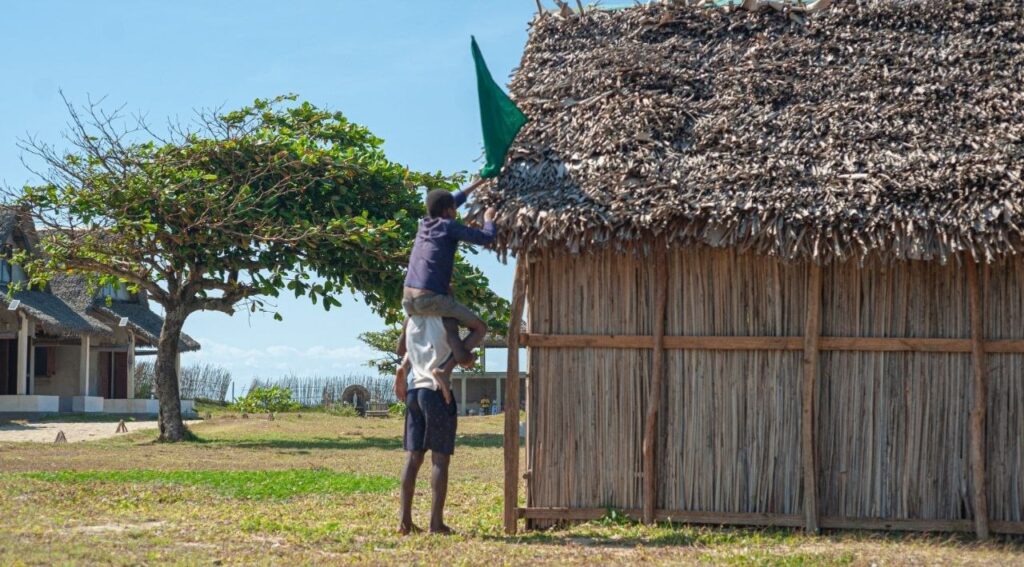
The University of Reading along with ARAKE, a non-governmental organization (NGO) based in Madagascar, now offers a programme called “SAP Kiddo”, co-developed within the REPRESA project alongside local children, parents, teachers and leaders as co-researchers. The programme aims to support children on the island through child-centred activities to raise awareness related to early warning systems and disaster preparedness in the face of more frequent and intense tropical cyclones under a changing climate.
SAP Kiddo weaves together education, creative engagement, and participatory activities to empower young voices and foster early awareness of disaster risks. So far, the program has reached over 3,000 children in Madagascar. Initially launched through its involvement as a partner organization in REPRESA, working with the University of Reading, ARAKE has embraced SAP Kiddo as a part of the organization’s broader program of work, with an intention to continue beyond the end of the project.
Why does it matter?
This change is significant because it marks a major shift in how climate resilience is conceptualized and practiced in Madagascar. Children are among the most vulnerable to the impacts of cyclones and related flooding in Madagascar, which are becoming more frequent and intense in the context of climate change. Children, in particular, face heightened risks during and after such climate-related disasters, including displacement, disruption of schooling, increased exposure to diseases such as malaria and skin infections, and psychosocial stress. However, conventional early warning systems have often been designed by and for adults, resulting in alerts that are neither accessible nor actionable for children and their caregivers especially those facing intersecting forms of marginalization such as poverty, geographic isolation, disability, or gender-based discrimination.
SAP Kiddo addresses this gap by placing children at the centre of early warning and resilience-building efforts. The initiative not only adapts messages to be child-friendly, understandable, and culturally relevant, but also creates structured opportunities for children to learn, engage, and participate in preparedness activities. This represents a key contribution to intergenerational resilience: children are no longer positioned solely as passive recipients of protection, but as knowledgeable actors capable of contributing to household and community preparedness.
SAP Kiddo ensures that the different experiences of boys and girls and of children with disabilities, children in remote areas, and those from low-income households are recognized and addressed by explicitly applying an intersectional lens. This strengthens equity within adaptation efforts, helping prevent the reinforcement of harmful gender norms or the exclusion of marginalized groups. The programme also has the potential to shift community perceptions around whose knowledge counts, promoting greater voice and leadership among girls and other typically underrepresented children such as street kids. In doing so, it supports a more inclusive, rights-based approach to climate adaptation.
SAP Kiddo contributes to socially inclusive and sustainable resilience by embedding intersectionality into climate action, elevating children’s perspectives, and ensuring that adaptation systems are accessible, equitable, and capable of responding to the realities of those most at risk.
What did CLARE do to contribute?
The University of Reading and ARAKE as project partners within the REPRESA team co-developed the SAP Kiddo program alongside community members, based on evidence of the vulnerability and potential role of children in the face of increasingly frequent and severe tropical cyclones. REPRESA Madagascar’s introduction of an intersectional methodology applied both as a theoretical framework and as an operational approach ensures that climate change adaptation strategies explicitly account for the layered and interconnected vulnerabilities different groups experience. In a context where cyclones and related flooding are increasing in intensity, recognizing these differentiated impacts is essential for designing effective, socially inclusive responses.
The University of Reading and ARAKE’s commitment to continuing the initiative as a part of their collaborative work beyond the project demonstrates the effectiveness of south-north co-construction and the collaboration between academia and non-academic organizations as part of CLARE’s transdisciplinary approach to climate adaptation research. ARAKE’s membership in the REPRESA project team as a locally based NGO helps to ground the research in the challenges faced by communities in Madagascar, and also contributes to ownership of the solutions developed, with greater likelihood they will be taken forward beyond the project lifespan.
Learn more:
- ARAKE: SAP KIDDO Resilient Children and Youth
- Children at the Center of Disaster Preparedness in Madagascar | Global Center on Adaptation
About REPRESA:
The Resilience and preparedness to tropical cyclones across Southern Africa (REPRESA) project focuses on the impacts of tropical cyclones in Madagascar, Malawi and Mozambique. Southern Africa is highly vulnerable to the impacts of tropical cyclones, as seen in devastating events like tropical cyclone Idai in 2019. The existing early warning systems in the region are insufficient to prevent loss of life and economic hardship. REPRESA aims to address this gap by improving early warning systems, conducting research on changing cyclone attributes, and formulating adaptation options to enhance resilience.
Individual contributors to work on SAP KIDDO by the REPRESA Madagascar Team include Dr. Velomahanina Tahinjanahary Razakamaharavo, Fenosoa Andrianjakarivola, Gabin Dahad, Minohery Mahatoky, Anjarasoa Sedera Randrianirina, Tanjoniaina Livasoa Carenne Randrianjafy, Ny Ony Patricia Andriamahenintsoa, Kiadinantenaina Joelson Rakotoson, Lalatiana Farasoa Rakotondranaivo, Jean Robin Marolahy Solomampionona Randrianaivo, Ginot Rarivo, Samuel Andriambalohery, Lalaina Raymondson Andriamiharisoa, Tsanta Fifaliana Idealisoa, Sarah Genevia Malalatiana Remamy
Categories
Countries
CLARE Projects
CLARE Pillars
CLARE Themes
CLARE Topics
CLARE Partners