


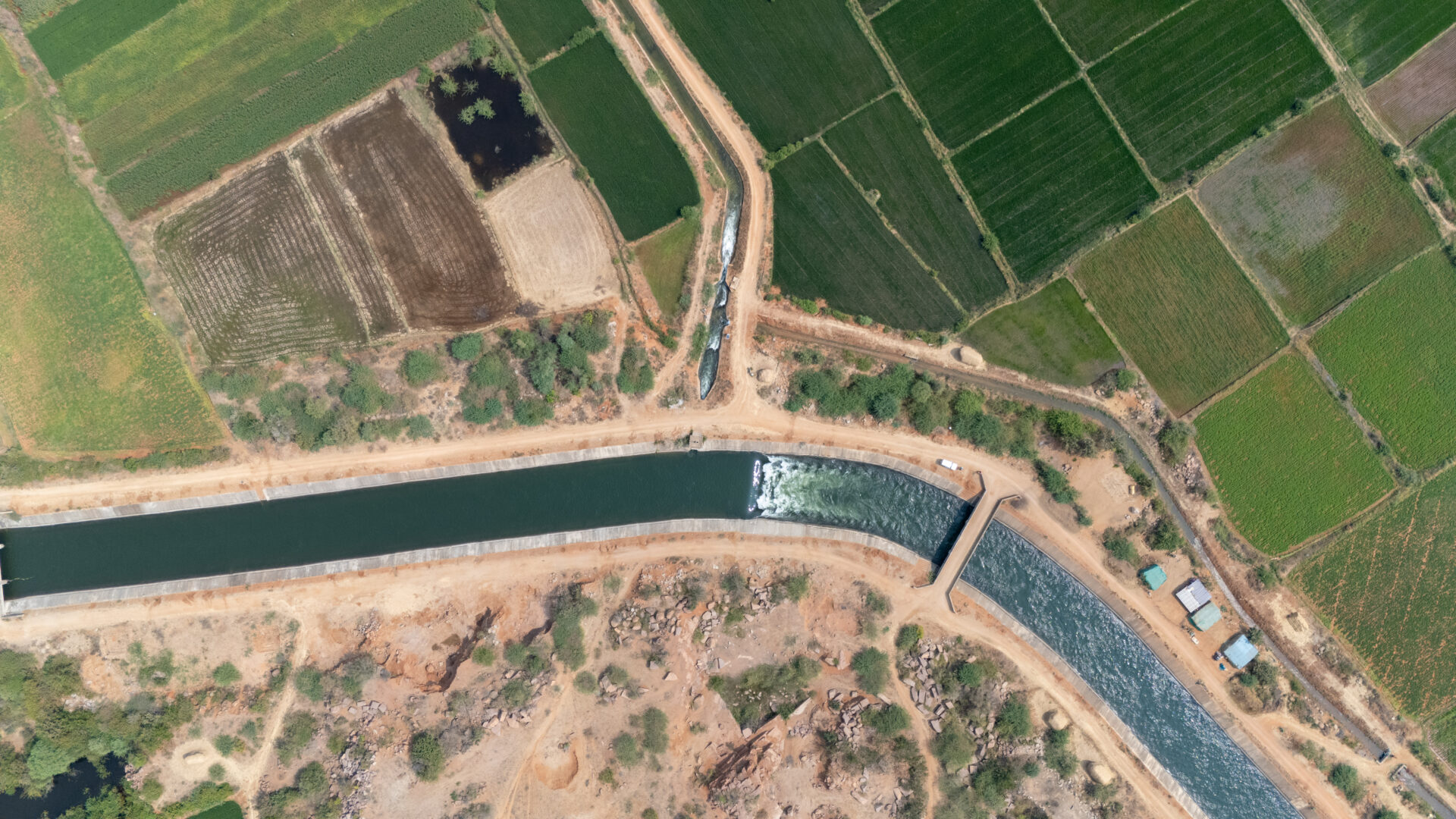
Closing the Water Gap: Why Raichur Needs Systems Transformation, Not Fragmented Efforts
/
Author: Syamkrishnan P. Aryan
Raichur district in Karnataka is nestled between two major rivers: the Krishna and the Tungabhadra. This geography would suggest an abundance of water and agricultural prosperity. Over the past four decades, massive investments have been poured into channelling river waters across the district through canals, distributary networks, and lift irrigation schemes. For instance, the Upper Krishna Project has received more than ₹10,400 crore in capital investment; this translates roughly to ₹1.67 lakh per hectare.
Yet, water inequity and inefficiency continue to define its agrarian landscape. In the Upper Krishna Project, little attention has been paid to maintaining and strengthening community ownership of the assets, or to building institutional capacity. Simultaneously, rainfed and watershed regions have received amounts only to the tune of ₹18,000–20,000 per hectare under watershed and MGNREGS works for land and water conservation. Soil organic matter restoration, protective irrigation for kharif crops, millet or alternate crop procurement systems, or livestock-based livelihood strengthening have largely been ignored.
This imbalance has created a paradox: overinvestment in canal infrastructure without sustained productivity gains, and chronic underinvestment in dryland systems that leave farmers vulnerable due to lack of access to irrigation. This inequity, combined with labour drudgery, limited access to diversified inputs, and weak market linkages, traps farmers across locations and water sources in different versions of low-level equilibrium, where they are forced grow only one crop, either due to unavailability of protective irrigation in dryland regions or due to flood irrigation in canal areas.
What appears to be a problem of water scarcity is, in reality, a systemic inefficiency and governance gap that prevents a transition toward diversified, climate-resilient agriculture.
The experience of the past few decades makes one thing clear: investing in water infrastructure alone is not enough. Strong local institutions to govern water, affordable regenerative inputs, labour-saving systems, and reliable markets for diversified crops are crucial to enable farmers to break out of monocultures, even in irrigated landscapes.
What Raichur needs, therefore, is not more investment in water; rather, it requires investment in the systems around water.
The Five Levers
Agriculture becomes climate-resilient when irrigation is integrated with soil health, labour productivity, local input ecosystems, and fair market access. Additionally, communities themselves should have the capacity to plan, manage, and sustain these systems.
Recognising that any change in agriculture will be impossible unless all interconnected systems are shifted simultaneously, WELL Labs, along with local civil society organisations and government, adopted a Five-Lever Approach to build resilient, diversified, and economically viable agriculture. Through the Raichur Transformation Lab¹, the approach works across infrastructure, technical capacity, labour, agricultural inputs, and markets, to improve water delivery and enable a locally anchored transition. Each lever responds to a structural constraint that locks farmers, especially smallholders, into high risk and low freedom contexts.
Figure 1: A graphical representation of the five-lever approach.

Source: Aparna Nambiar (WELL Labs)
Last Mile Infrastructure for Water Access and Control
Raichur’s last-mile irrigation infrastructure is characterised by earthen ditches, overgrown field channels, and outlets without functional control gates. Consequently, head-end farmers are forced to grow paddy, a water intensive crop that can tolerate continuous flooding due to uncontrolled flow of water in the last mile irrigation channels (also known as field irrigation channels). Over time, continuous monoculture and uncontrolled flood irrigation degrade soils and reduce yields.
Last-mile piped irrigation work near Narayanpura Right Bank Canal’s Distributary 10 in Raichur.

Photo credit: Vraj Acharya
Tail-end farmers face the opposite problem: unreliable access to water. Villages such as Mandalgudda, at the tail end of Distributary 14 of the Narayanpura Right Bank Canal, are restricted to single-crop systems despite living beside a canal network. Meanwhile, rainfed farmers on the periphery of canal commands live near natural streams, silted tanks, and even the Krishna River, but lack the protective irrigation infrastructure that could convert this proximity into water security.
Strengthening infrastructure through last-mile pipelines, controlled outlets, protective irrigation systems, and conjunctive water use (using both groundwater and surface water) can enable farmers to manage water, rather than react to it.
With the ongoing canal automation project and the successful pilots of last-mile piped irrigation channels, Raichur has a unique opportunity to shift from flood irrigation to reliable, measured water delivery.
Technical Capacity for Water Governance
Karnataka’s Water User Cooperative Societies (WUCS) were created to manage, operate, and maintain last-mile irrigation and ensure fair water sharing. Unfortunately, most of these remain weak or inactive. Some canal command areas have fewer than 2% active societies. This results in poor maintenance of irrigation infrastructure, irregular water scheduling, head-end farmers dominating water use, and tail-end or rainfed farmers having little-to-no voice in water management.
Men twisting the screw jack of sluice gate for Distributary 95 near Tungabhadra Left Bank Canal in Raichur.

Photo credit: Nanditha Gogate
Consequently, farmers lack information on water releases, even where canals or pipelines exist; are not capacitated to plan collectively; and have no effective mechanism to resolve conflicts or negotiate for equitable water.
To shift irrigation governance from informal, individual-driven control to collective, evidence-based management, building technical capacity within WUCS (through embedded community hydrologists, such as Jal Vigyanis) and transparent, data-informed decision-making processes is critical. While WUCS exist currently only in canal command areas, there is potential to create such societies around lift irrigation and groundwater sharing systems. Strengthening this institutional–technical backbone is crucial to ensuring that water systems remain fair, reliable, and sustainable across both canal command and rainfed landscapes.
Read also | A Collective Path to Sustainable Groundwater Use in Semi-Arid India
Optimised Labour Requirements and Reduced Drudgery for Diversified Agriculture
Labour shortages and drudgery are among the most binding constraints preventing Raichur’s farmers from shifting away from monoculture. While diversified cropping systems (incorporating existing and suitable high value crops, such as groundnut, chilli, cotton, or pulses) are preferable, adopting them requires performing laborious and repetitive tasks, such as timely weeding and staggered harvesting, that fall disproportionately on women. In many villages, women spend four–six hours a day, holding hand hoes and bending over to weed small plots; work that could easily be replaced by women-friendly tools and machinery.
Women harvesting cotton in Raichur.

Photo credit: Nanditha Gogate
In villages like Sirwar, Maski, and Sindhanur, labour costs triple during peak seasons because of unavailability of skilled labour. Farmers mention that a single weeding cycle for chilli can cost ₹8,000–₹12,000 per acre. Those who want to grow nutrient-rich crops like millets or pulses hesitate because these crops require manual weeding and harvesting that households simply cannot manage.
Read also | Addressing the Labour Barrier in the Transition to Crop Diversification
Consequently, many farmers continue growing paddy, which has readily available mechanised options (like combined harvesters) and doesn’t require regular weeding.
Youth migration further deepens the problem, with young men leaving for cities; farm labour, which involves manual drudgery, is not considered aspirational, and mechanised farm services are yet to evolve as an alternative. Even if farmers do end up owning small machines for weeding and harvesting diverse crops, lack of access to repair services will cause the equipment to lie unused for months.
Improving labour productivity through small-scale mechanisation, ergonomic tools for women, trained machine operators, and village-level rental and repair services can make diversification realistic and less exhausting. Moving this lever ensures that ecological transitions do not depend on human drudgery, especially women’s, but rather are supported by modern, accessible, and locally managed labour solutions.
Ready Availability of Alternative Agricultural Inputs
A major hidden factor locking farmers into monoculture is the input ecosystem. Today, 40–60% of the per-acre cost of cultivation in Raichur comes from chemical fertilisers, pesticides, and other synthetic inputs (e.g. herbicides and insecticides). A national fertiliser subsidy of ₹1.67 trillion for chemical fertilisers, and the competitive rural market penetration of agri input companies has ensured that these chemical inputs are visible and easily available in local retail shops.
Women preparing Jeevamrutha, a natural bio-fertilizer, which helps improve soil health and promotes healthy crop growth.

Photo credit: Ganesh Masnur
By contrast, farmers who want to adopt natural or regenerative practices face multiple barriers: local unavailability of natural inputs; time-consuming and drudgerious preparation requirements; unavailability of pulses, millets, or oilseed seeds at dealers; and absence of village-level supply chain for organic bio-inputs. Even though the Government of India has a target of creating 10,000 bio-input resource centres for localised production, there have been challenges in its implementation. Without accessible natural inputs and seeds for diversified crops, farmers, especially smallholders, will be unable and unwilling to shift to new farming systems.
Community-managed Bio-Resource Centres and village-level entrepreneurs can close this gap by providing inputs such as bio-fertilisers, pest repellents, organic nutrients, and diverse seeds at the right time and at affordable prices. Moving this lever can reduce cultivation costs, improve soil health, and mainstream sustainable cropping practices.
Market Linkages and Value Addition for De-Risking Market Challenges
Even if all the four constraints mentioned above are addressed, farmers will not shift to diversified cropping systems unless they are confident that markets will reward the change. Today, market infrastructure in Raichur strongly favours paddy and cotton, with established procurement centres, subsidised inputs, predictable buyers, and strong input–output ecosystems.
A scene from the Raichur Mandi.

Photo credit: Nabina Chakraborty
By contrast, in a diversified cropping system, small quantities of multiple crops like millets, pulses, vegetables, or oilseeds suffer from limited economies of scale with the absence of market aggregation, absence of cleaning, drying, and grading facilities, volatile pricing, and lack of value-addition opportunities in the village. Strengthening farmer collectives to overcome these obstacles can create market confidence and make diversified cropping economically attractive.
When farmers are assured of being able to sell diversified produce at fair prices, they can safely move out of monoculture traps. This lever ensures that diversification is not only environmentally sound but also financially rewarding.
The Need for a Systems Transformation
The idea for the Five Lever approach was born during a visioning workshop conducted in Raichur. Participating farmers voiced their willingness to shift to a diversified cropping system, provided they had control of water, and access to labour, market, and other ecosystems (such as input). Today, Raichur stands at a crossroads. Continuing with fragmented, scheme-driven interventions will only reproduce the same inequities: canal infrastructure without equitable distribution; watershed works without productivity gains; and farmers trapped in monocultures despite rising investments.
What is needed now is a systems transformation that aligns infrastructure, governance, labour, inputs, and markets into a coherent whole. When these levers move together, they create an ecosystem of support and a circular local economy, where water is collectively managed, inputs are locally produced, services generate rural employment, and diversified crops find reliable markets. In such a system, public investment no longer dissipates across disconnected schemes; rather, it compounds into lasting equity, resilience, and shared prosperity for farmers and allied stakeholders alike.
¹Transformation Lab or T-Lab is an approach wherein regions are considered as labs in which to test hypotheses, taking into consideration the interconnected constraints. It generates innovations that can overcome lock-ins and create seeds of change that can potentially have a transformative impact on the broader society towards sustainability.
Published on WELL Labs – Click here
Published
CLARE Partners