
Story of change: Co-creating climate solutions with members of informal communities in the Philippines
Published on
Authored by the RURBANISE team
CLARE Stories of Change are snapshots of how research and capacity strengthening initiatives that the programme supports are contributing to specific changes on the ground in support of resilience to climate change and natural hazards. They help illustrate how CLARE is enabling socially inclusive and sustainable climate resilience, as outlined in the CLARE Theory of Change.
What changed?
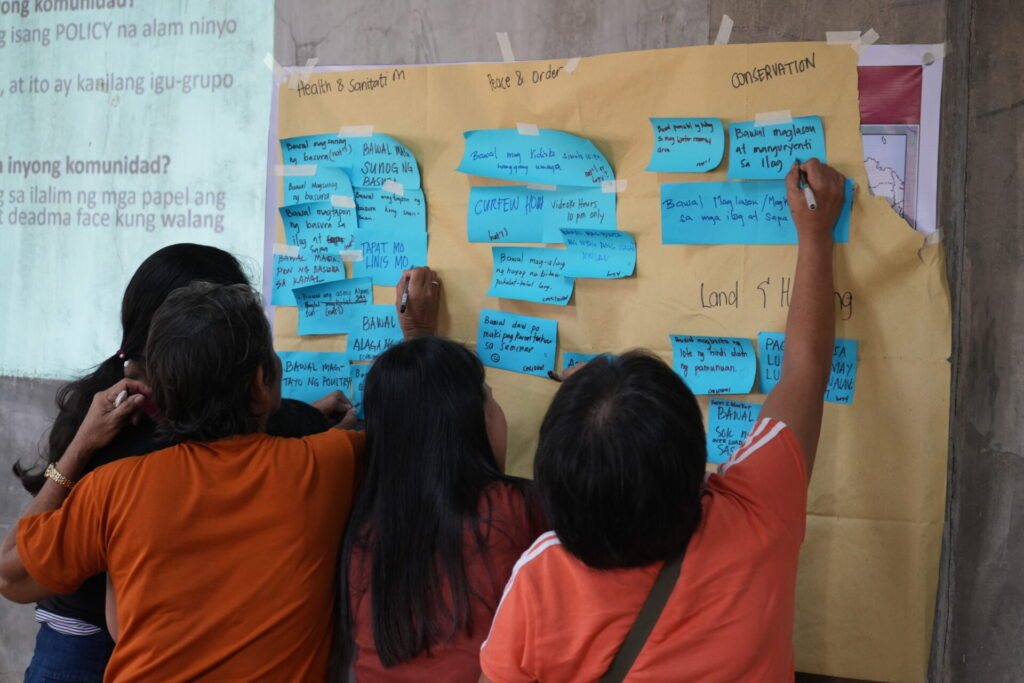
Community members in seven informal communities in the Philippines are working alongside scientists, architects, engineers, and NGOs to produce evidence and pilot solutions to address climate risks. This includes, for example, mapping key hazard-prone areas – such as areas prone to flooding – and exploring the potential for locally deployed environmental sensors to provide early warning. In the process, these communities are strengthening internal coordination and applying local knowledge.
Through their engagement in the RURBANISE project, community members have moved from identifying the climate-related challenges they face to proactively identifying solutions, such as accessing funds for adaptation and disaster risk response and engaging in municipal land use planning processes.
Why does it matter?
The Philippines is highly exposed to the impacts of climate change, including more frequent and intense typhoons, sea-level rise, and increased heat and rainfall. At the same time, almost a quarter of the country’s 113 million inhabitants live in informal urban and peri-urban settlements. The combination of rapid urbanization, loss of natural ecosystem buffers such as wetlands and mangroves, combined with climate-related impacts create complex, cascading risks for communities living in informal settlements. The growing leadership and agency that communities are demonstrating through their engagement with RURBANISE mark important steps toward long-term outcomes such as informed collective action for resilient development in these contexts under a changing climate.
What did CLARE do to contribute?
RURBANISE works directly with residents of informal settlements, offering targeted capacity strengthening for community members across its seven partner communities. To date, women have represented most community participants in RURBANISE activities. This capacity strengthening work is part and parcel of the project’s regular engagement with community members, undertaken through participatory action research. Through interaction with communities, there is space to share local knowledge and learn perspectives from scientists, local officials, and other stakeholders. The RURBANISE team also takes time to present foundational concepts and answer questions to ensure communities are well equipped to participate in discussions and have relevant background information to eventually advocate for their rights, needs, and priorities.
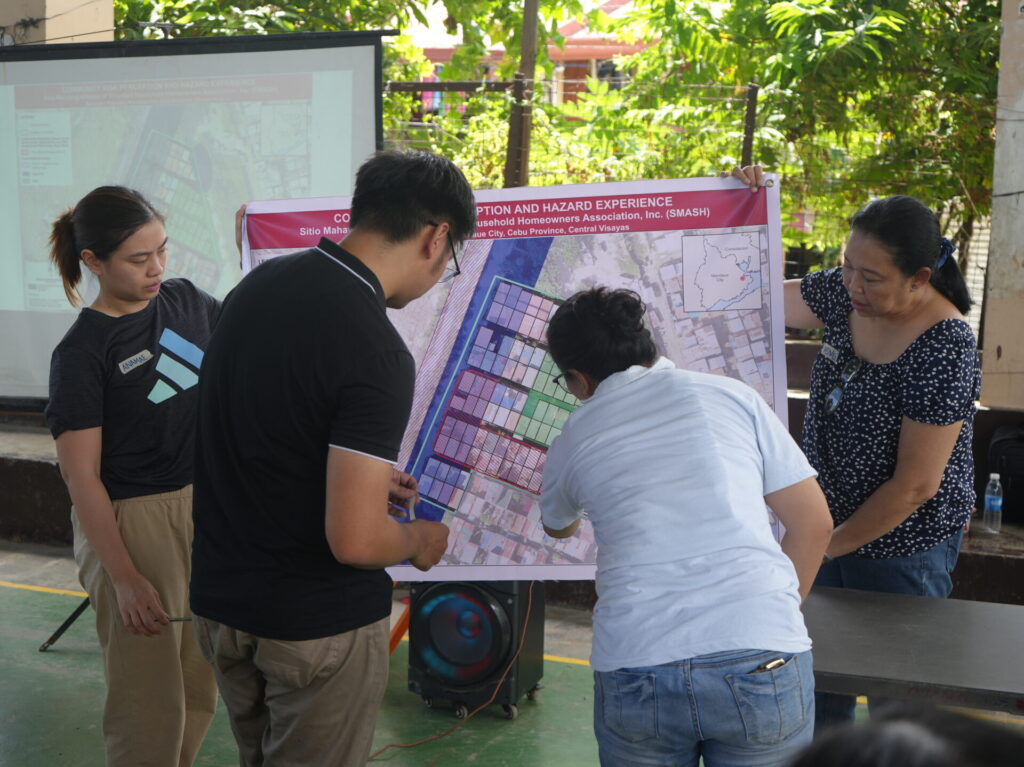
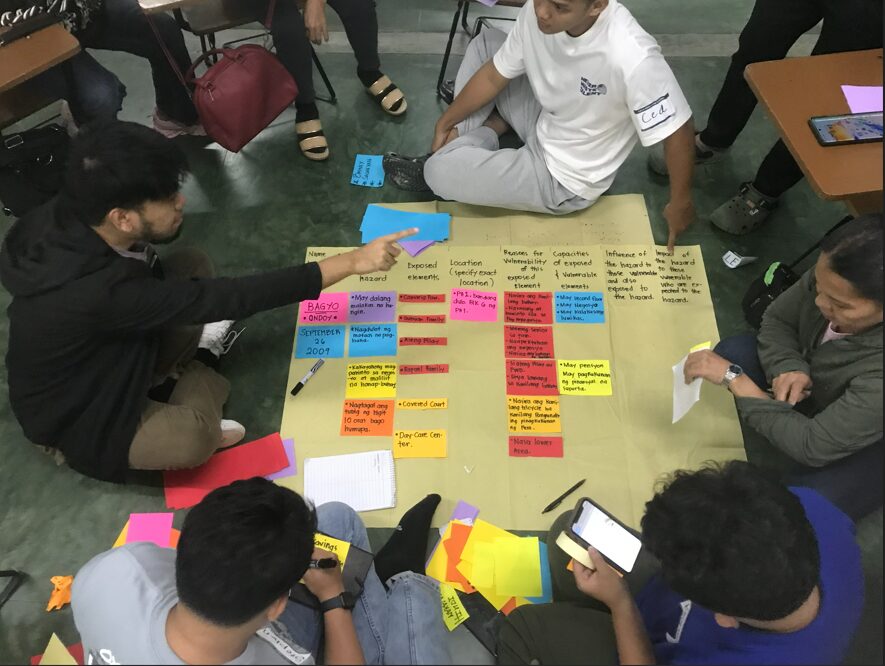
For example, the team led an orientation on Disaster Risk Reduction and Climate Change Adaptation (DRR-CCA) that introduced community members to key topics such as hazards, exposure, vulnerability, and capacity. The orientation also covered the principles of Community-Based Disaster Risk Reduction and Management (DRRM) and the Philippine DRRM System. In addition to conventional capacity strengthening activities, the team works co-creatively across partner communities to identify risks and solutions, contributing to strengthened agency and capacity. For example, the team has run participatory risk mapping processes, visualizing community knowledge through community risk perception and hazard experience maps .
Work with local enumerators
Team members from the University of the Philippines Planning and Development Research Foundation, Inc. (PLANADES) trained 15 community members to conduct household level surveys collecting data on the vulnerabilities of the families in the communities that RURBANISE works with. Community members were selected to conduct this survey to build data collection capacities and to be able to take ownership of the data being collected.
During the training, technical proficiency and ethical integrity were taught to ensure that the survey being conducted met academic standards. The training emphasized “active interviewing”, where the enumerators could probe for clearer answers without leading the respondent. This was done through a walkthrough of the questionnaire where the PLANADES team helped the enumerators-in-training identify potential ways to phrase asking the questions. By mastering the logic of the tool through identifying skip patterns and data validation rules, the community members were able to develop the troubleshooting skills necessary to handle unexpected responses or technical glitches independently in the field.
Overall, this activity facilitated a co-creation approach instead of a top-down instruction style. The activity employed role-playing, where enumerators would practice with the tool on each other. Creating a safe space for the community members to practice these skills built their confidence to be deployed to the field.
About RURBANISE
The Resilience of informal communities in rapid urbanization (RURBANISE) project deepens understanding of the different ways in which residents of informal settlements in the Philippines are vulnerable to climate-related risks by actively engaging those communities in the process.
The project mobilizes and enhances existing and potential capacities to strengthen effective responses for climate adaptation in nine informal settlements and to deliver inclusive, practical adaptation actions.
Categories
Countries
CLARE Projects
CLARE Pillars
CLARE Themes
CLARE Topics
CLARE Partners