
Building Institutional Capacity Through Evidence and Collaboration
/
For decades, investments in research capacity have often focused on increasing funding, supporting individual researchers, or strengthening scientific infrastructure. While these interventions are important, one critical question has frequently received less attention:
Are universities and research institutions themselves institutionally equipped to sustain climate adaptation research?
The Understanding African Universities’ Capacity for Climate Adaptation Research: Co-creating and Implementing a Climate-focused Organizational Capacity Assessment Tool (CO-CAT) project is helping answer this question, and more importantly, helping African universities and research institutions act on the answer. Through a collaborative process of co-creation, institutional learning and evidence generation, the project has guided participating institutions from developing and piloting the CO-CAT, an organisational capacity assessment tool, to using its findings to drive institutional collaboration, targeted capacity strengthening and organisational transformation.
The CO-CAT comprises a comprehensive organisational assessment framework spanning ten critical institutional domains, including Climate Science and Technical Capability, Adaptation Science and Systems Thinking, Interdisciplinary and Cross-Sectoral Collaboration, Gender, Equity, Ethics and Social Inclusion (GESI), Policy and Institutional Engagement, Communication and Stakeholder Engagement, Leadership and Strategic Direction, Monitoring, Evaluation, Learning and Adaptation (MELA), Organisational Learning and Knowledge Systems, and Resource Mobilisation and Financial Sustainability. Designed to foster evidence-informed institutional reflection, the framework provides a clear understanding of where institutional strengths exist, where strategic improvements are required, and how organisational systems can be strengthened to better support climate adaptation research.
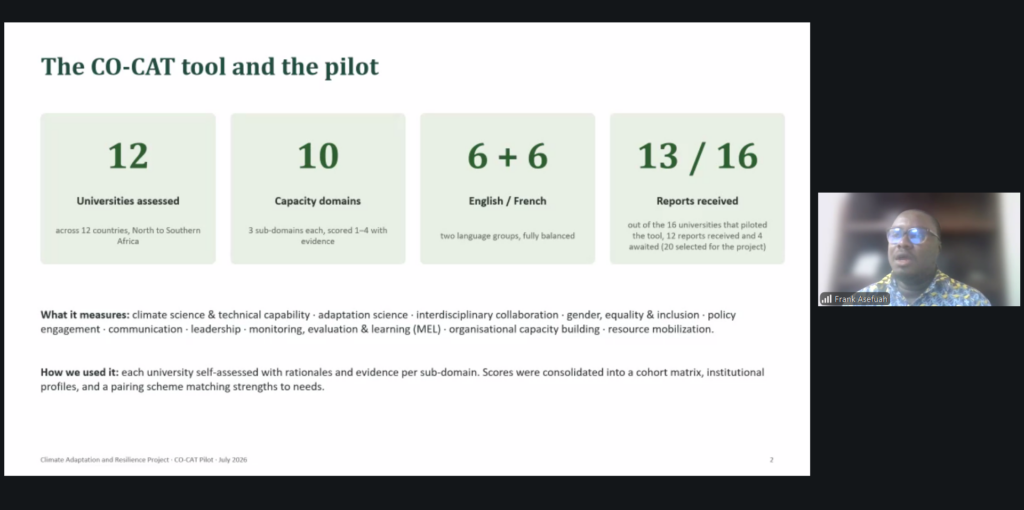
Through this process, 16 participating institutions across the continent have generated robust evidence on their organisational capacities. The assessment findings now serve as a strategic roadmap for organisational development, guiding participating institutions in translating evidence into targeted actions that strengthen their research systems and long-term resilience.
Beyond informing individual institutional priorities, the assessment also provided insights into the broader organisational landscape across the participating institutions. The evidence reveals that many organisational challenges are shared rather than isolated, creating opportunities for collective action and collaborative problem-solving. Resource mobilisation and long-term financial sustainability, for instance, emerged as recurring priorities across several participating institutions, underscoring the need for coordinated interventions that complement institution-specific support while strengthening resilience across the wider network.
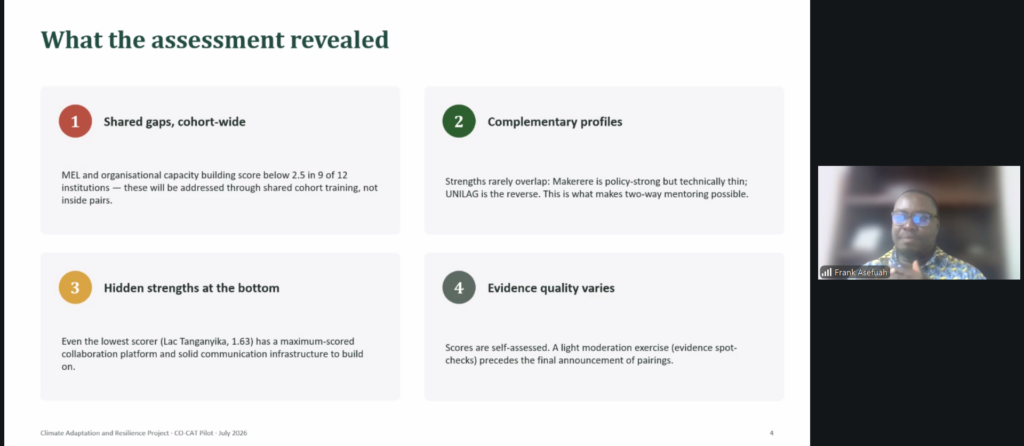
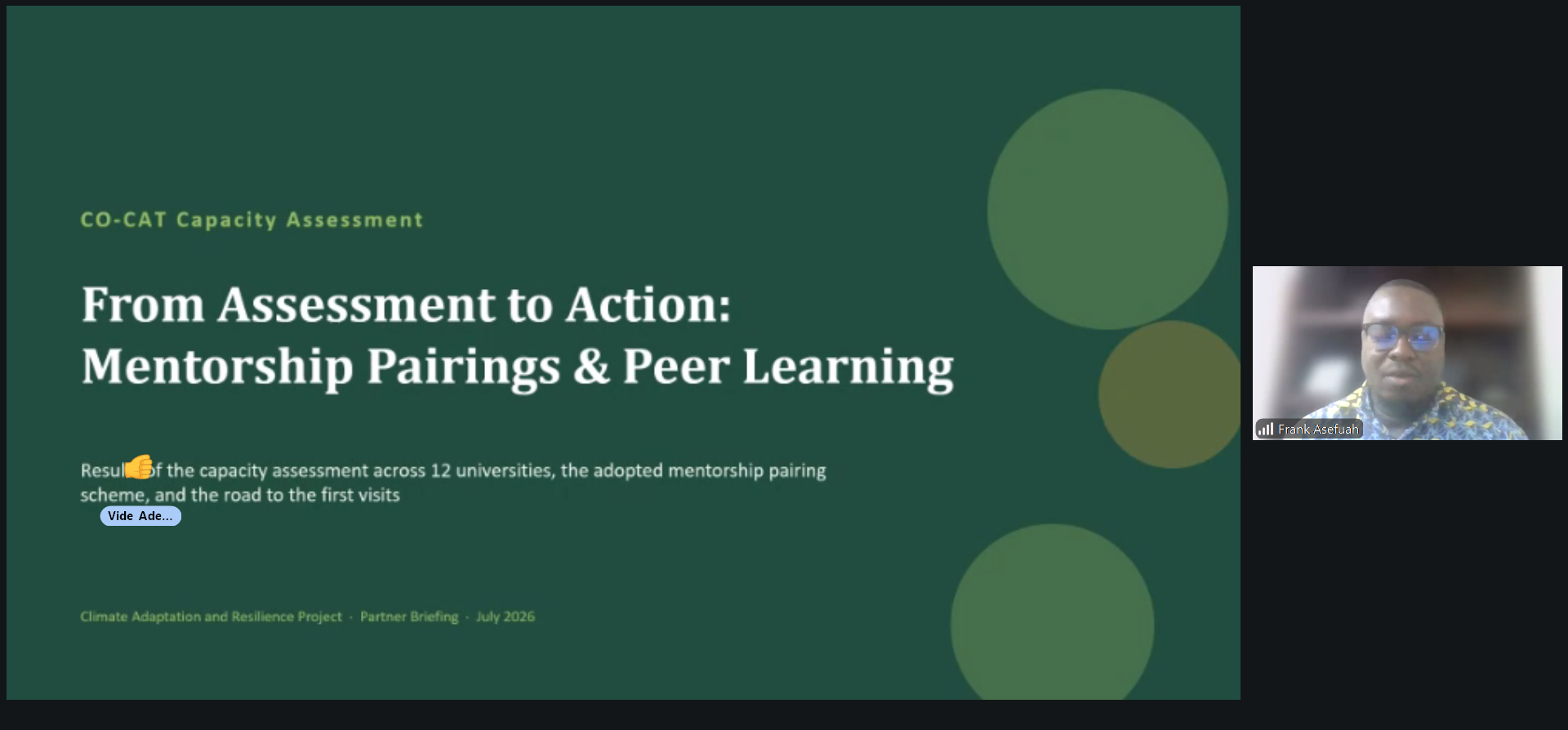
Building on the evidence generated through the assessments, the CO-CAT project has launched the next phase of implementation through a strategic institutional pairing model that connects participating universities and research institutions with complementary strengths and capacity needs, creating opportunities for targeted learning and collaboration. Unveiled during the CO-CAT Piloting Results Meeting on 31st July 2026, the pairing transforms assessment findings into practical partnerships, enabling institutions with demonstrated expertise in specific organisational domains to mentor and learn alongside peers seeking to strengthen those same areas.
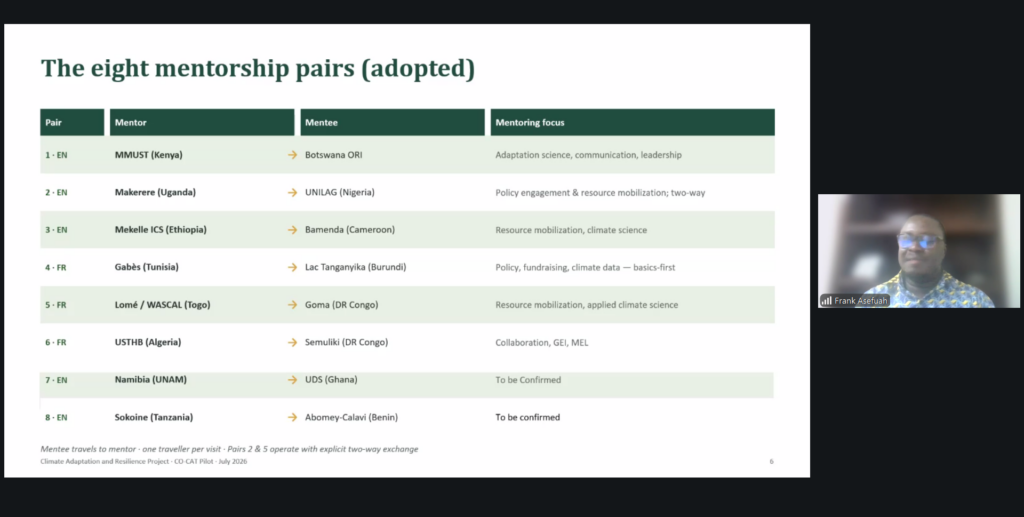
Through structured mentorship, reciprocal peer learning and collaborative institutional exchanges, participating institutions will co-develop practical solutions, adapt proven approaches and accelerate organisational improvement. More importantly, this redefines capacity strengthening by recognising African universities and research institutions as producers of knowledge and drivers of institutional innovation, capable of strengthening one another through structured collaboration and shared experience.
These activities will be complemented by monitoring and evaluation processes that document institutional change, capture lessons learned and develop case studies showcasing practical examples of organisational transformation across participating institutions. Beyond measuring progress, the evidence generated through this implementation phase will play a critical role in refining and strengthening the CO-CAT framework, ensuring that it continues to evolve as a practical, evidence-informed tool for institutional capacity development.
The value of the CO-CAT project extends far beyond the institutions currently participating in its implementation. As mentorship visits, peer-learning exchanges and monitoring activities unfold, each institutional experience will generate new evidence that will refine the assessment tool, strengthen its practical application and enhance its relevance for African higher education. Through this continuous cycle of implementation, learning and refinement, the project is establishing a sustainable, African-led model for organisational capacity strengthening, one that can be adapted, scaled and continuously improved to support universities in building stronger research systems, advancing climate adaptation research and strengthening institutional resilience across the continent.
Participating Institutions: University of Science and Technology Houari Boumediene (Algiers), Makerere University, Sokoine University of Agriculture, Masinde Muliro University of Science and Technology (MMUST), Mekelle University – Institute of Climate and Society, The University of Bamenda, Université du Lac Tanganyika, Official University of Semuliki, University of Goma – School of Volcanology and Disaster Risk Management, University for Development Studies, University of Abomey-Calavi, University of Lagos, University of Botswana – Okavango Research Institute, University of Namibia (UNAM), University of Gabès, and the University of Lomé.
About the CO-CAT Project
The Understanding African Universities’ Capacity for Climate Adaptation Research: Co-creating and Implementing a Climate-focused Organizational Capacity Assessment Tool (CO-CAT) is a 24-month initiative funded mostly (about 90%) by the UK Foreign Commonwealth Development Office (UK FCDO), and co-funded by the International Development Research Centre (IDRC), Canada, through the CLimate Adaptation and REsilience (CLARE) program. It is implemented by the Association of African Universities (AAU), the Association of Commonwealth Universities (ACU), and the Liverpool School of Tropical Medicine (LSTM). The project aims to strengthen the capacity of African universities and research institutions to undertake impactful climate adaptation research through the co-creation and piloting of an organisational capacity assessment tool that supports the strengthening of institutional research systems for climate adaptation and resilience.
Categories
Countries
CLARE Pillars
CLARE Themes
CLARE Topics
Published
CLARE Partners