
“Resilience starts at home”: Kanyama’s and Makeni’s Satellite Disaster Risk Management Committees take everyday risk reduction to the International Day for Disaster Risk Reduction march in Lusaka
/
Author: Katharine Vincent
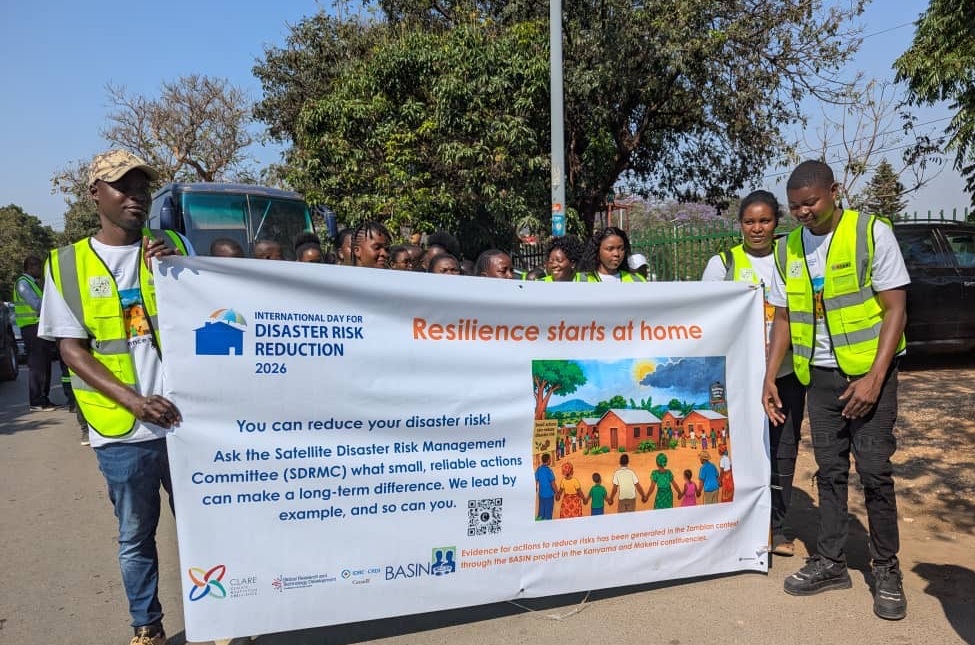
On Tuesday 13 October, 13 members of Kanyama’s and Makeni’s Satellite Disaster Risk Management Committees (SDRMCs) joined the International Day for Disaster Risk Reduction march in Lusaka, Zambia. In keeping with this year’s theme, “Resilience starts at home”, they carried a simple message: you do not have to wait for others to act, because there is a lot you can do yourself, at home, to reduce your risk from extreme weather.
From sharing forecasts to showing what acting on them looks like
SDRMC members already volunteer to identify and support vulnerable neighbours before, during and after floods and other extreme weather events. Through the Behavioural Adaptation for Water Security and Inclusion (BASIN) project, they have been working with researchers to understand what affects the uptake of climate information. This helps to unpack the use side of climate services: research has largely concentrated on whether people can access and understand information, and less on what they do with it.
Making the behaviour chain visible
Research on actions taken in response to weather information typically relies on one-off, retrospective methods, such as interviews asking people what they have done. These are subject to recall bias, and some actions are likely to be missed, particularly where several follow in sequence. How people take in a source such as the weather forecast is also often implicit, so they may not consciously link it to what they do next.
To make the chain from receiving weather information to acting on it more visible, a sample of Kanyama and Makeni residents has been invited to report twice weekly, via a brief online form, on actions they have taken because of what they knew about the weather. Collection began a year ago, and the dataset now comprises 1,619 reported actions. The data are self-reported and come from volunteers, so they are not representative. They do, however, offer novel insights into the use side of climate services, and provide information that can be used to inform actionable disaster risk reduction messaging.
A handout built from what people report doing
The UN Office for Disaster Risk Reduction frames this year’s theme largely around housing, governance and investment, alongside risk-informed action by households. BASIN and the SDRMCs have taken it to mean, in addition, that resilience starts at home with you. Many actions that reduce risk are within the control of individuals, households and small businesses, and do not depend on anyone else acting first.
The SDRMC members carried an illustrated handout distilled from the 1,619 actions reported over the last year. It is organised around the decisions people face when the weather changes: protecting property, communicating with others, wearing the right things, planning the day, protecting livelihoods, and preparing children.
The advice includes fastening roofs and covering the gaps beneath doors before heavy rain, rescheduling trading or manual work when it is very hot or wet, drying vegetables and fish for later use, and looking out for people with disabilities, older people and single mothers. It therefore reflects what residents report doing rather than expert prescription; whether each action is effective is a separate question that the dataset cannot answer on its own.
Sharing the message is a key responsibility for the SDRMCs, and one they take very seriously. As SDRMC member Alice Chileshe notes, “Our goal is sharing the information to the most vulnerable people, persons living with disabilities, and elderly people on hot they can take care of themselves before, during and after disasters”.
At the march
The march brought together all those who are committed to building resilience in Zambia, chaired by the Vice President, under whose office the Disaster Risk Management Division sits. It was also accompanied by a small clean up exercise in which everyone participated.
Malawo Siamalyata, an SDRMC member from Kanyama, explained what taking part meant to him: “It showed that we are part of the broader system that is committed to building resilience, and reminded [us] that we all have a role to play”. Fellow members Naomi Mwanza and Andrew Tembo added: “We have long known that charity starts at home, and now we know resilience begins at home too”.
What next
The march adds to something SDRMC members have shown in other settings, namely that trusted volunteers can carry both information and example into everyday spaces. BASIN will now analyse the dataset as part of its research on what influences the uptake of climate information. We want to know which actions are most commonly reported, and which factors, such as information source, trust in the messenger, resources, and household and social context, make acting on information more or less likely.
Categories
Countries
CLARE Pillars
CLARE Themes
CLARE Topics
Published
CLARE Partners