
“We now have a voice, we now have a choice:” A young woman farmer’s journey to being in charge of her own life, one click at a time
/
Florence Kyoheirwe Muhanguzi, Brenda Boonabaana, Phionah Birungi, Susan N Kavuma, Joab Ezra Agaba Restituta Bogere and Peruth Naturinda
In the heart of Uganda’s cattle corridor, where the sun rises over rolling hills and sets behind verdant gardens, Hawa Tukahirwa 21years old expecting mother, is rewriting the rules. By leveraging the digital tools, specifically a smartphone, she’s transforming her family and community using locally driven climate and weather informatics to address climate shocks especially drought. The Women Smallholder Farmers Empowerment and Resilience (WOSFER) project, a collaborative effort between Makerere University, Institute of Gender and Development Studies and the Association of Professional Women in Agriculture and Environment (AUPWAE) with support from the International Development Research Center (IDRC) and Foreign Commonwealth Development Organization (FCDO), is redefining what is possible for women smallholder farmers across Uganda’s cattle corridor. By strengthening their empowerment and adaptive capacity, the project has sparked a quiet revolution, one where women are no longer passive participants, but active drivers of change within their households and communities.
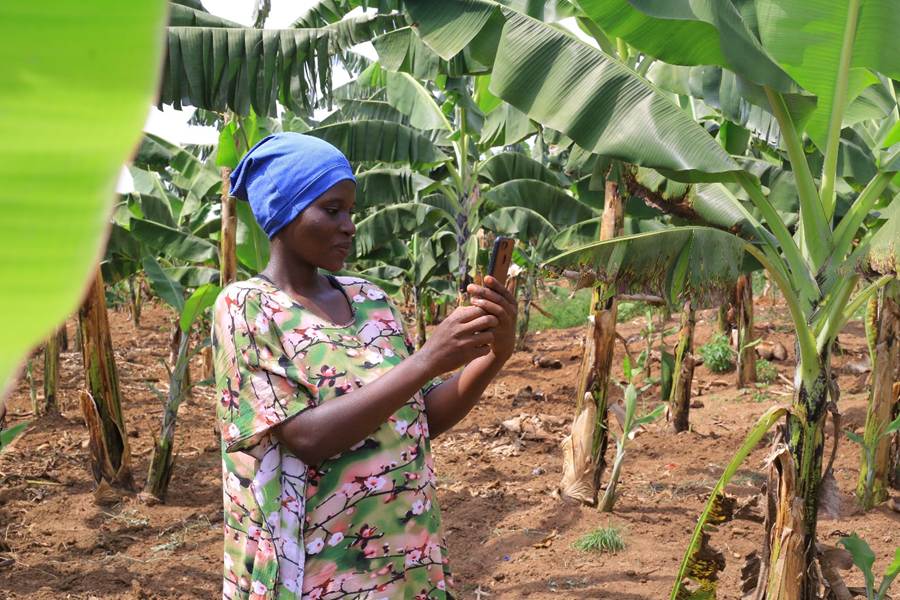
Photo: Hawa Tuhakirwa, a digital champion captures images of banana plants affected by Banana Bacterial Wilt to send to extension workers
Hawa’s journey began with a series of trainings, including climate-smart agriculture, gender equality, equity and digital literacy, as part of the WOSFER project a 3.5-year initiative supported by IDRC and FCDO under the Climate Adaptation and Resilience (CLARE) initiative. Today, Hawa is a voice of change, a leader and a connector.
With her phone in hand, she shares vital information on weather patterns and farming decisions, helping fellow women to plan better, adapt faster and take control of their livelihoods. As evidence to this ongoing transformation, Hawa noted: “I use my phone to tell fellow women about weather patterns, when to clear their gardens, it has changed our mindset as women.” This means that Hawa’s phone is more than a device. It is a lifeline, a tool for supporting herself, other women smallholder farmers, and the wider community’s agri-weather information needs. This has implications for wellbeing at personal, household, and community levels, as these provide empowerment pathways. The phone is not just a symbol of independence but a spark for collective progress among women, their households, and the wider community.
Hawa is no longer walking the journey alone. Her husband, Turyamulebwa, is right by her side, learning, adapting and growing with her. “We now share responsibilities, and he helps with household chores,” Hawa shares with a smile. Hawa’s transformation at home tells an equally powerful story, driven by the Gender Action Learning System (GALS) methodology, which is reshaping relationships as well as livelihoods. This shift is more than support; it is a quiet revolution. Traditional roles are being redefined, replaced by partnership, respect and shared ambition, not only in Hawa’s family but across the two project districts.
As Hawa’s phone buzzed with updates, her impact ripples far beyond her household. In Rwamabara Zone A village, she passes on critical knowledge to fellow women, guiding them on weather patterns, farming decisions and digital tools. So far, she has reached out to 29 women and 30 households, a testimony to her incredible local mobilization for change and self-determination. She is part of a growing movement of over 300 women trained in digital literacy and climate smart agriculture, connected through vibrant village clusters that are fast becoming hubs of learning, innovation and mutual support.
What makes this change even more powerful is that couples are learning together. Joint training in smartphone usage for agricultural growth are breaking the long-held barriers, strengthening households and building unified visions for the future.
The impact of the WOSFER PROJECT is undeniable. Over 5,000 people reached, 20 village clusters established and a wave of empowerment spreading across Lyantonde and Katakwi districts.
At the heart of it all, are women like Hawa and her fellow digital champions, whose impact extends beyond their gardens. “I have seen women transform, gain confidence and take charge of their lives,” she beams with pride.
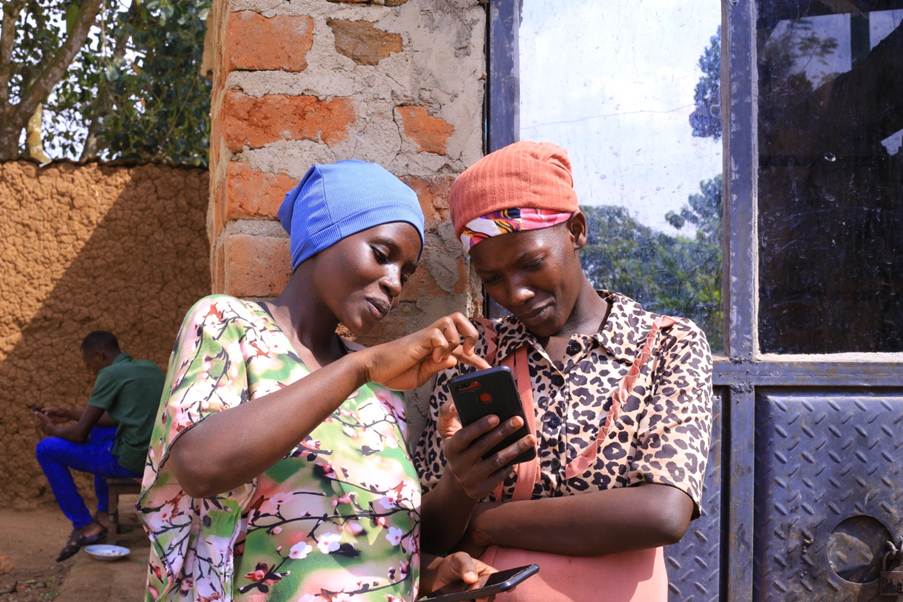
Photo: Hawa showing her fellow woman how to send messages using a smart phone
Hawa continues to unpack her experiences noting that “The WOSFER project has changed our lives. We now have a voice…” says Hawa Tuhakirwa, her words echoing the sentiments of countless women who have benefited from the initiative. Her husband, Turyamulebwa, adds, “The project has empowered me to take charge of my life, my family and my community,” a testament to the project’s ripple effect on households and communities.
Through this partnership, women like Hawa are breaking barriers, embracing digital literacy and cultivating a brighter future for themselves, their families, and their communities. This is a reflection of a model that drives local change and wellbeing in the face of emerging climate shocks and persistent social vulnerabilities. Given the right interventions, men, women, and communities are willing to learn, relearn, and unlearn to challenge their vulnerabilities.
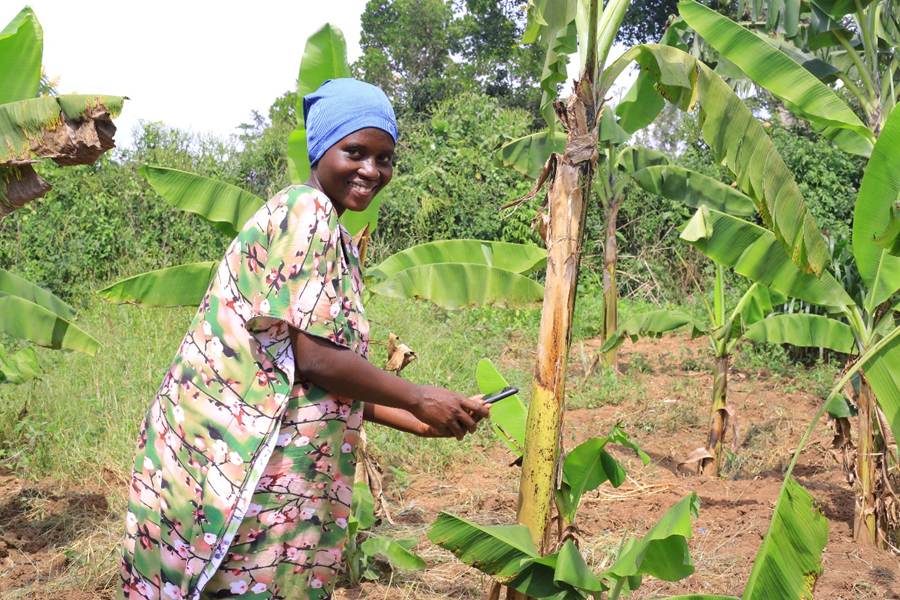
Photo: Hawa in her garden, using her phone with a hopeful smile
Hawa says, “to build on the WOSFER Projects’ momentum, I recommend scaling up the initiative to reach more women, communities and widen adoption of the interventions. Integration of digital literacy and climate-smart agriculture into national policies will ensure sustainability and wider adoption of the initiatives.” Ongoing support and training for smallholder women farmers empowers them to continue driving change.
Overall, Hawa’s story is a testament to the power of digital literacy, climate-smart agriculture, and gender transformative training models towards individual, household, and community empowerment. As she looks out at her garden, she’s not just seeing crops – she sees a brighter future that integrates many community members to build their own lives and sustain them. Her journey inspires hope, demonstrating what can be achieved when women (alongside men) are equipped with the right tools, support, and enabling environment.
Categories
Countries
CLARE Pillars
CLARE Themes
CLARE Topics