

Rethinking Communication for Climate Adaptation from Dissemination to Impact
/

Authors: Ursulla Wandili, Maureen Kabasa, Monroe Dikiny
Introduction
What happens when important climate adaptation research fails to influence the decisions it was meant to inform?
Despite growing investment in climate adaptation research, much of the knowledge produced still struggles to shape policies, programmes, and action on the ground. Valuable evidence often remains confined to reports, workshops, and academic outputs, raising an important question about whether communication is being treated as an integral part of adaptation work or simply as a final dissemination step. Research on science–policy engagement has long shown that evidence alone does not automatically influence decision-making processes (Cash et al., 2003).
Communication plays a critical role in determining whether research becomes actionable, understood, and trusted within decision-making spaces. Yet in many climate adaptation initiatives, communication is still approached primarily as the production of outputs such as reports, presentations, policy briefs, or visibility materials. These outputs remain important, although they do not automatically lead to engagement, uptake, or influence. Recent climate adaptation literature increasingly emphasises that communication effectiveness depends on relevance, trust, interaction, and usability within specific decision contexts (Jacob et al., 2025).
The CLARE Capacity Strengthening (CS) Hub Communication and Dissemination Learning Series created space for researchers and practitioners to rethink how climate adaptation research is communicated and used. The learning process brought together researchers, communication professionals, Research-for-Impact practitioners, and project implementers working across climate adaptation initiatives. The sessions encouraged participants to reflect more deeply on the purpose of communication and its role in supporting adaptation impact.
Learnings from the Communication and Dissemination learning series.
Communication Needs to Support Influence and Engagement
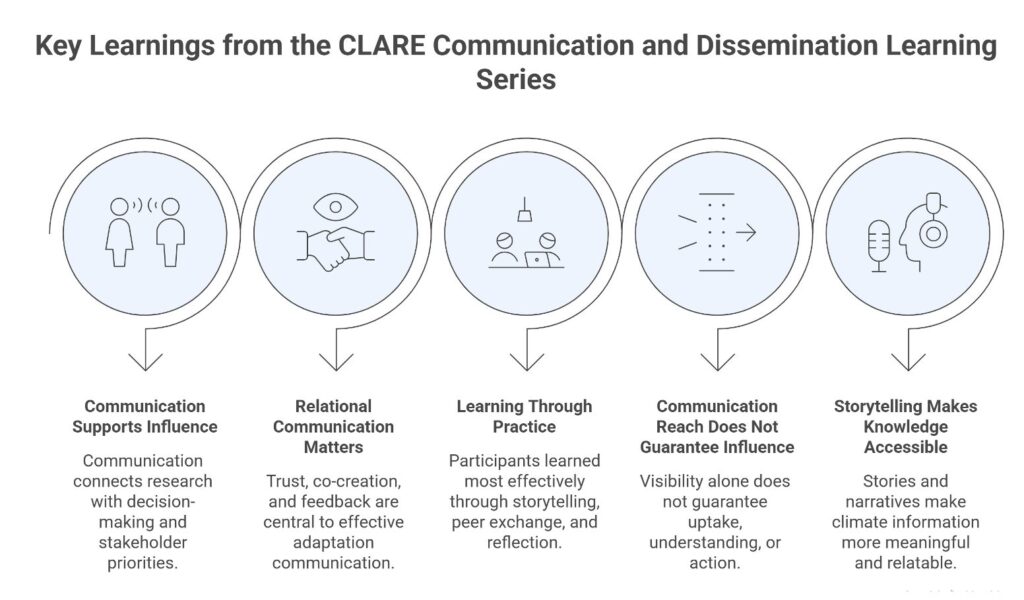
One of the clearest lessons emerging from the learning series was the growing recognition that communication needs to support influence, engagement, and decision-making. Before the sessions, many participating projects described communication mainly in terms of sharing research findings or increasing visibility. Fewer than 40% of participating projects reported having a formal communication or dissemination strategy, while many identified policy engagement, communicating with non-specialist audiences, and stakeholder engagement as major challenges.
As discussions progressed, communication increasingly became understood as a process linked to relationships, interaction, and the practical use of knowledge. Participants began reflecting more critically on questions such as: Who are we communicating with? Why does this audience matter? What kind of change are we trying to influence? And what happens after communication takes place?
These reflections revealed an important shift in thinking. Communication was no longer viewed simply as the transfer of information from researchers to audiences. Participants increasingly described communication as a process shaped by dialogue, trust, participation, and continuous engagement.
Relational Communication Matters
A strong theme emerging from the learning process was the importance of relational communication. Participants consistently highlighted the value of co-creation, feedback, and sustained stakeholder engagement. Group discussions, marketplace sessions, and practical exercises created opportunities for participants to test ideas, refine messages, and learn from one another’s experiences. Communication was increasingly described as something developed with stakeholders through interaction and shared learning.
These experiences reflect broader evidence emerging from climate communication and social learning research. Studies on adaptation and knowledge exchange show that communication becomes more effective when it supports dialogue, participation, and collaborative learning through continuous interaction and engagement (Ensor & Harvey, 2015).
Learning through Practice Strengthens Communication Capacity
The learning series also highlighted the importance of applied and practice-oriented learning. Some of the most significant shifts occurred when participants worked directly on communication challenges linked to their own projects. Through storytelling exercises, audience mapping, message-framing sessions, and communication planning activities, participants explored how adaptation research could become more accessible, audience-focused, and decision-relevant.
These practical exercises revealed that communication capacity cannot be strengthened through theory alone. Communicating climate adaptation research often involves judgement, negotiation, interpretation, and responsiveness to context. It requires understanding not only what information needs to be shared, but also how different audiences engage with knowledge, what influences decision-making processes, and how trust is built over time.
Communication Reach Does Not Always Lead to Influence
Another important reflection emerging from the learning series was the distinction between communication reach and communication influence. Participants reflected on instances where communication outputs generated visibility or engagement but did not necessarily lead to understanding, uptake, or action. This prompted deeper discussion on what effective communication actually means within climate adaptation programmes.
In many cases, participants recognised that influencing policy or practice requires sustained engagement, identifying appropriate entry points, understanding institutional dynamics, and aligning communication efforts with decision-making contexts. Research on evidence-informed policymaking similarly demonstrates that timing, framing, and political context strongly shape whether evidence informs action (Oliver et al., 2014).
Storytelling Makes Adaptation Knowledge More Accessible
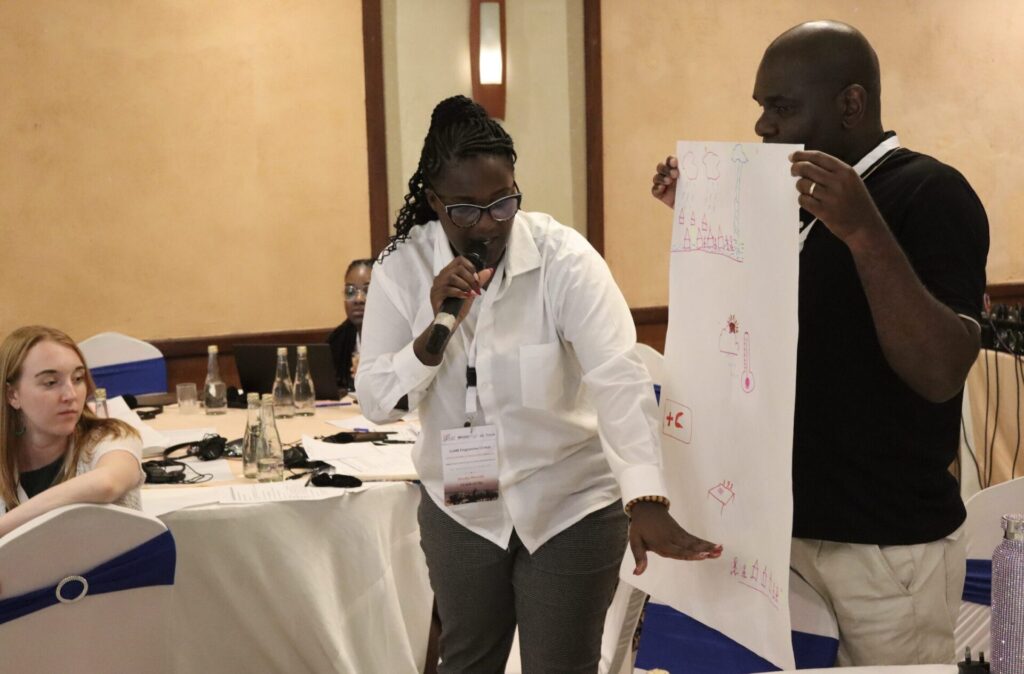
A session at the Communication and Dissemination Session. Photo Credit: Fiona Makayoto – ACTS
The learning series further reinforced the growing importance of storytelling and participatory communication approaches within climate adaptation work. Scientific evidence remains essential, but evidence alone does not always create connection or inspire action. Participants explored how storytelling, visual communication, and locally grounded narratives could help make adaptation knowledge more relatable, accessible, and meaningful for diverse audiences.
Conclusion: Communication as Part of Adaptation Impact
The experiences emerging from the CLARE Communication and Dissemination Learning Series point to a broader lesson for climate adaptation research. Communication cannot remain a final step added after research is completed. It must become part of how adaptation knowledge is produced, interpreted, shared, and used.
As climate risks intensify and adaptation decisions become increasingly urgent, strengthening communication capacity will be essential not only for improving visibility of research, but for ensuring that knowledge contributes meaningfully to action, policy, and community resilience.
Climate adaptation research has the potential to shape transformative change. Realising that potential, however, depends not only on the quality of evidence produced, but also on whether communication creates understanding, trust, engagement, and pathways for action.
References
- Cash, D. W., Clark, W. C., Alcock, F., Dickson, N. M., Eckley, N., Guston, D. H., Jä Ger J., & Mitchell, R. B. (n.d.). Knowledge systems for sustainable development. https://www.pnas.org
- Jacob, D., Lera St. Clair, A., Mahon, R., Marsland, S., Ndebele Murisa, M., Buontempo, C., Pulwarty, R. S., Siddiqui, M. R., Grossi, A., Steynor, A., Mugandani, R., Alexander, L. V., Ruane, A. C., Doblas-Reyes, F. J., List, G., Wolff, M., & Noori, S. (2025). Co-production of climate services: challenges and enablers. Frontiers in Climate, 7. https://doi.org/10.3389/fclim.2025.1507759
- Oliver, K., Lorenc, T., & Innvær, S. (2014). New directions in evidence-based policy research: A critical analysis of the literature. In Health Research Policy and Systems (Vol. 12, Issue 1). BioMed Central Ltd. https://doi.org/10.1186/1478-4505-12-34
Categories
Countries
CLARE Pillars
CLARE Themes
CLARE Topics
Published
CLARE Projects
CLARE Partners