
We must act: Key CLARE interventions for global heatwave preparedness
/
Findings from the CLARE Programme in Africa and Asia offer practical insights for contexts around the globe as heatwaves become increasingly frequent and severe.
Evidence and emerging findings from CLARE demonstrate how researchers, policymakers, and communities can drive action that mitigates the impacts of extreme heat on human health, economic stability, and public infrastructure.
According to Limiting Overshoot, a landmark report by the UN Environment Programme (UNEP), global warming is projected to exceed 1.5°C, reaching at least 1.8°C. The report warns that without rapid action, heatwaves will strike faster, hit harder, and last significantly longer.
Right now, El Niño conditions are set to influence global weather and rainfall patterns, with Above average temperatures forecast nearly everywhere, according to the World Meteorological Organization (WMO).
By building on key lessons from CLARE projects in Africa and Asia, institutions managing heat policy and infrastructure can make evidence-informed decisions that strengthen resilience and ensure a safer future.
1. African project leads on how severe heat actually feels—and why that matters
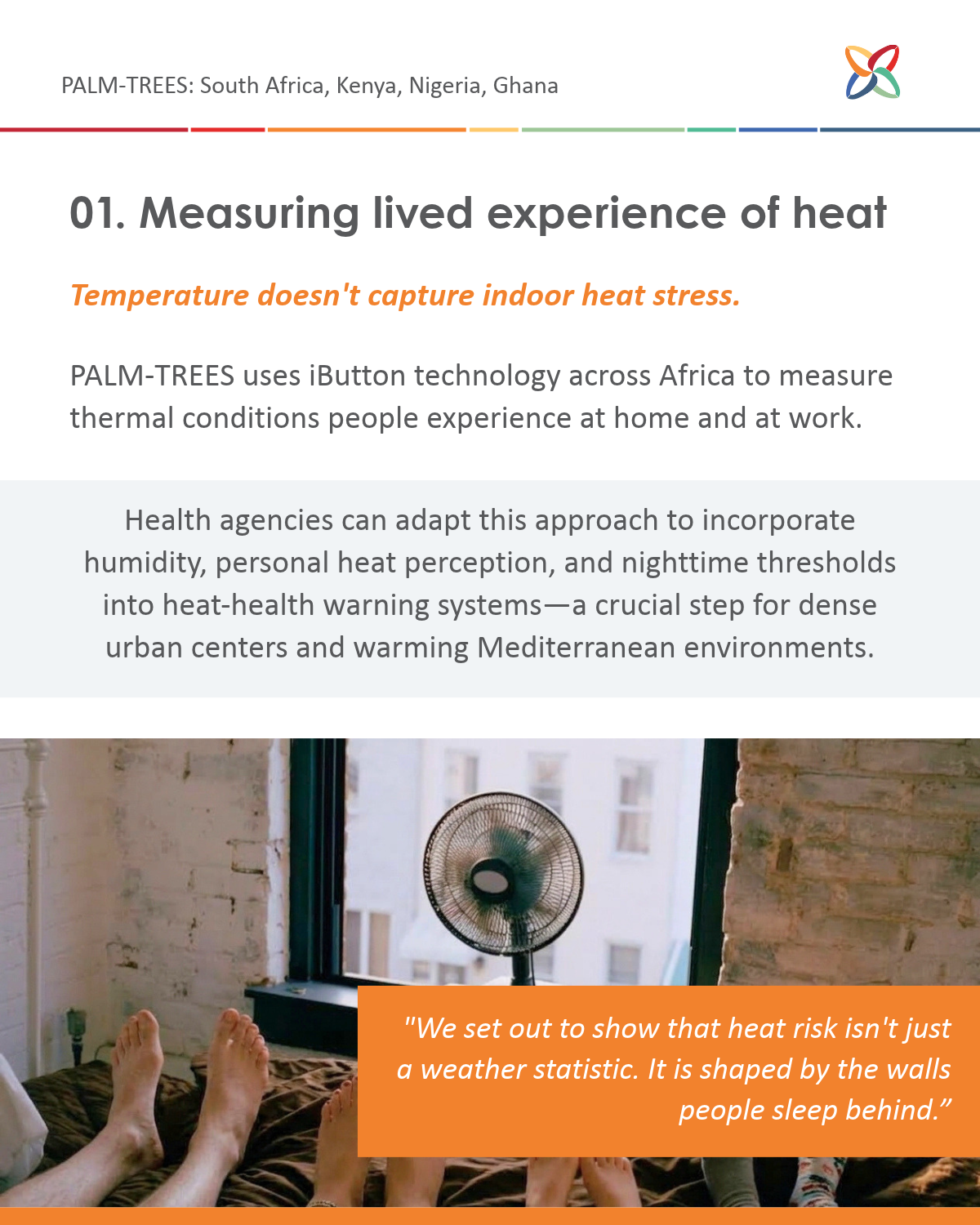
Standard heat warnings often rely on ordinary air temperatures measured by a standard thermometer – but the conditions people actually experience vary significantly. Better local data can help us understand who is experiencing heat stress and why – and ensure warnings consider all those at risk.
- CLARE Project: PALM-TREEs
- The Innovation: Deploying iButtons, small, durable temperature and humidity data loggers, across Africa to capture the thermal conditions people experience in their homes and places of work. These measurements are combined with people’s own accounts of how they experience heat, helping researchers connect physical conditions with lived experience.
- Global Relevance: By combining sensor data with people’s lived experiences, PALM-TREEs is building a more detailed understanding of where and when heat risks are greatest. This evidence could help authorities design heat warnings and responses that better reflect local conditions.
“We set out to show that heat risk isn’t just a weather statistic. It is shaped by the walls people sleep behind. When a home stops offering the body a chance to recover, the house itself becomes part of the hazard.”
— Clinton Ogolla, National Drought Management Authority (NDMA), Kenya
2. No air conditioning? Try these cooling building design lessons from Southeast Asia
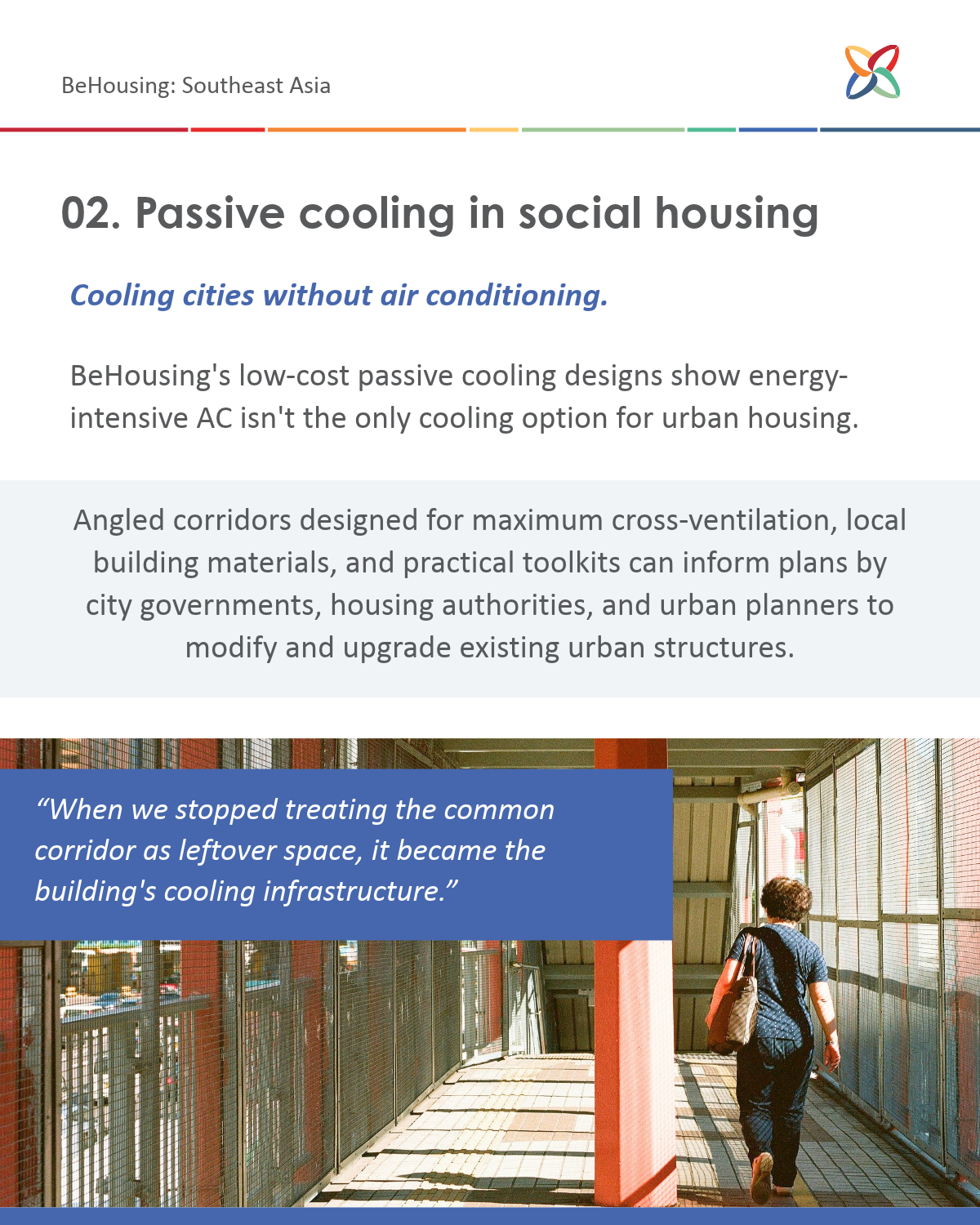
As cities struggle with indoor heat stress in public housing—where residents face high energy costs, poor insulation, and limited temperature control—building design strategies offer an effective way to keep buildings cool without relying on high-cost air conditioning.
- CLARE Project: Be-Housing
- The Innovation: Pioneering multi-story housing designs in Malaysia and Indonesia, where common corridors are angled and shaded to maximize cross-ventilation, transforming circulation spaces into passive cooling shelters.
- Global Relevance: Be-Housing’s focus on low-cost retrofits, local building materials, and practical “housing upgrading toolkits” provides city governments, housing authorities, and urban planners with scalable templates to adapt existing urban infrastructure.
“We stopped treating the common corridor as leftover circulation space. Angled and shaded correctly, and with cross ventilation, it became the building’s cooling infrastructure.”
— Resident / Project Participant, Kampung Akuarium
3. A Bangladeshi blueprint for safeguarding frontline workers
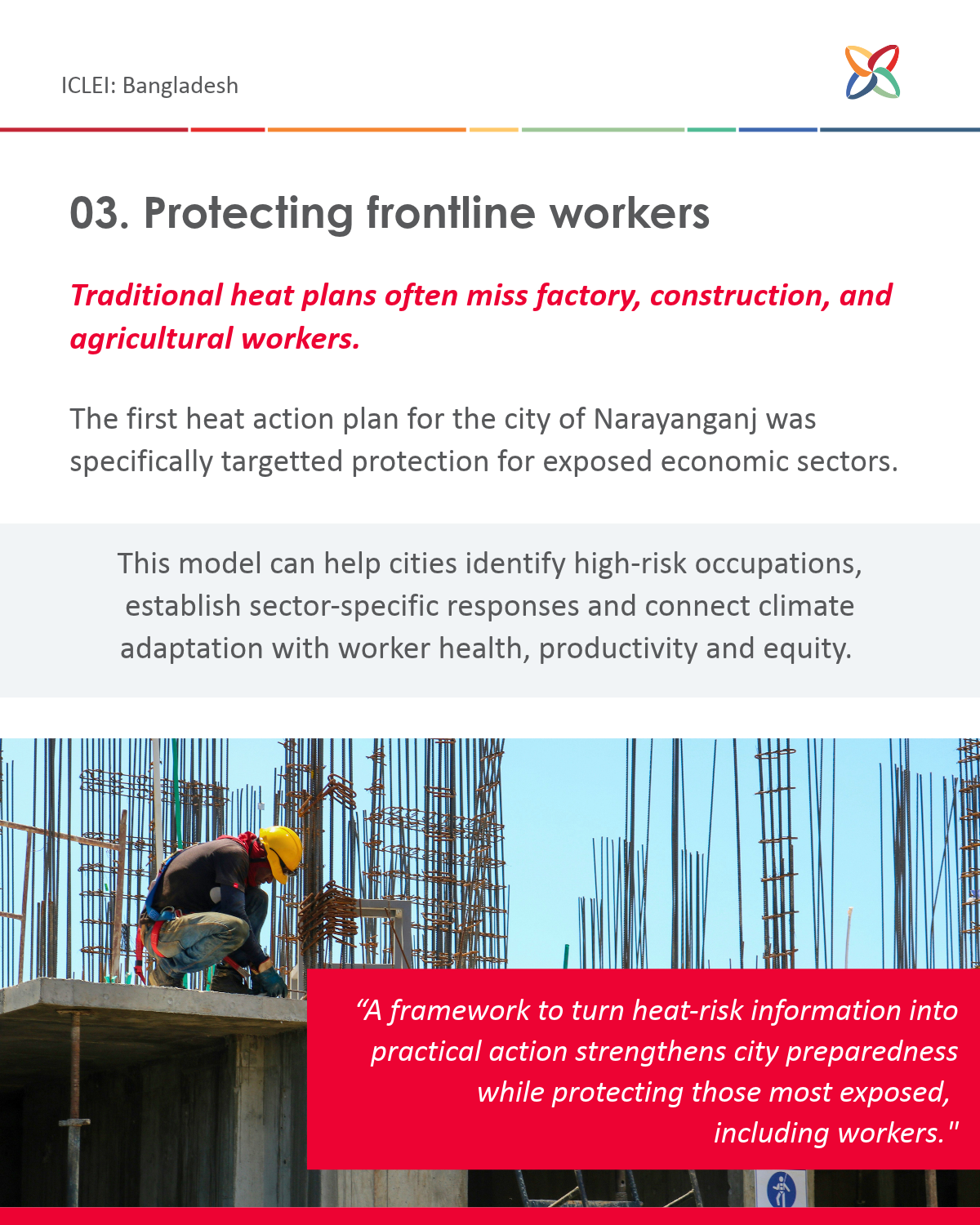
Traditional heat action plans often focus on vulnerable people at home, such as the elderly. However, extreme heat poses risks to labour-intensive sectors like construction, agriculture, and manufacturing.
- CLARE Project: R4I Opportunities Fund / ICLEI South Asia
- The Innovation: Developing the first comprehensive Heat Action Plan for Narayanganj, Bangladesh, a major industrial and textile hub where thousands of workers endure exposure in physically demanding outdoor and factory environments.
- Global Relevance: Narayanganj provides a blueprint for turning heat risk data into actionable workplace protections. It enables municipal authorities to identify high-risk occupations, establish sector-specific protocols, and connect climate adaptation directly to occupational health, worker safety, and economic equity.
“Our Heat Action Plan provides Narayanganj with a framework to turn heat-risk information into practical action, strengthening the city’s preparedness while protecting those most exposed, including workers.”
— Mr Md Moinul Islam, Chief Urban Planner, Narayanganj Municipality, Bangladesh
4. Rethinking heat risk for migrant women and informal communities
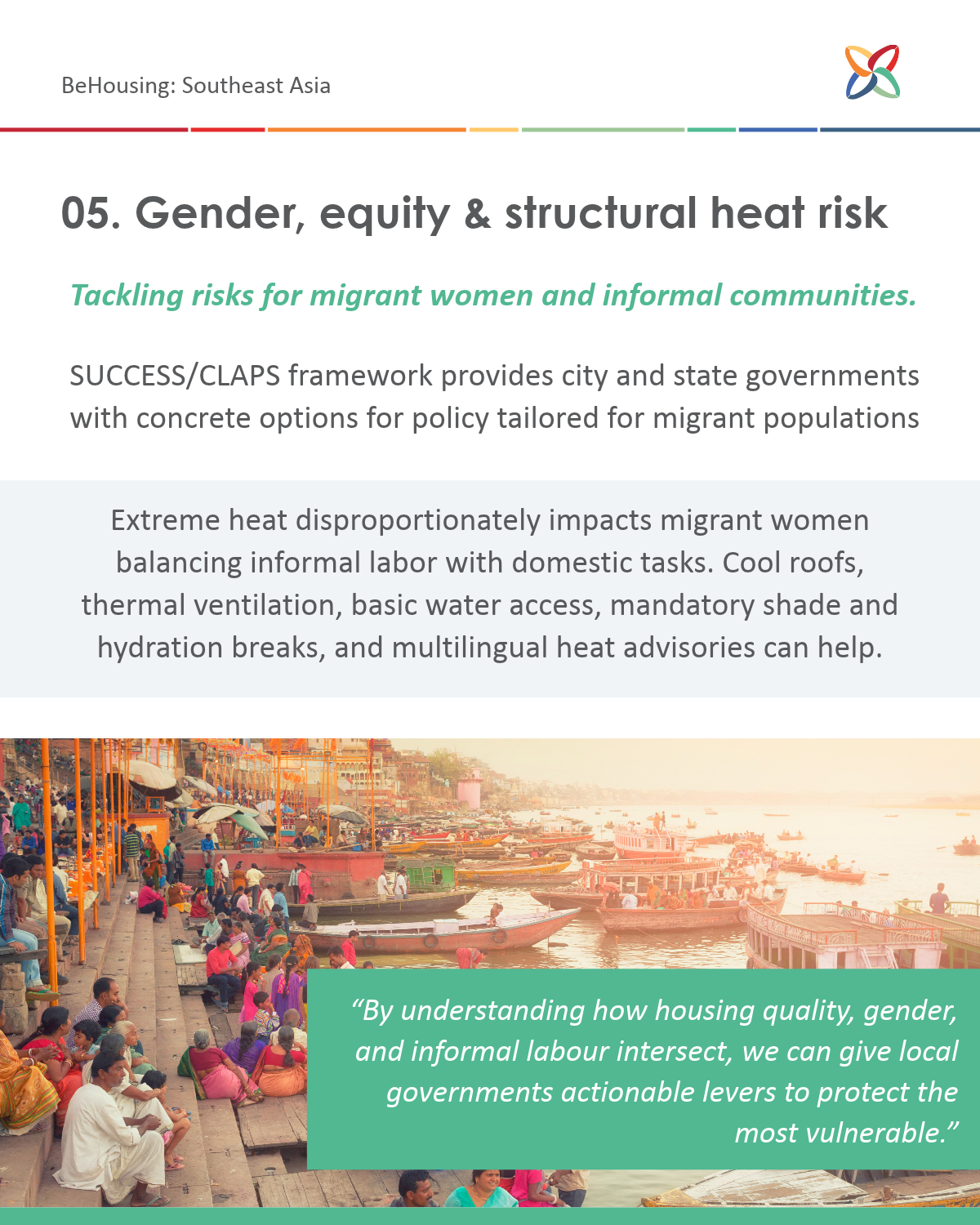
Extreme heat compounds existing inequalities. In low-income informal settlements, migrant women bear a double burden, enduring extreme temperatures during paid informal work, only to return home to cook and care in poorly ventilated shelters. Building resilience requires addressing these structural drivers of exposure alongside early warning systems.
- CLARE Project: SUCCESS / CLAPs
- The Innovation: Generating evidence on how gender, migration status, housing quality, and informal labour intersect to compound heat vulnerability across low-income Indian communities.
- Global Relevance: The SUCCESS/CLAPs framework provides city and state governments with concrete options for policy reform—from scaling cool roofs and thermal ventilation in informal housing, to guaranteeing basic water access, enforcing mandatory shade and hydration breaks, and deploying multilingual heat advisories tailored for migrant populations.
“Heat risk is not experienced equally. By understanding how housing quality, gender, and informal labour intersect, we can give local governments actionable levers to protect the most vulnerable, turning lived experience into concrete policy reform.”
— Swati Surampally, Project Representative, SUCCESS / CLAPs
Categories
Countries
CLARE Pillars
CLARE Themes
CLARE Topics
Published
CLARE Projects
CLARE Partners