
Story of Change: Scaling a Community Hydrology Training Curriculum in Karnataka State, India
Published on
Authored by Raichur T-Lab, CLARITY (WELL Labs – IFMR)
CLARE Stories of Change are snapshots of how research and capacity strengthening initiatives that the programme supports are contributing to specific changes on the ground in support of resilience to climate change and natural hazards. They help illustrate how CLARE is enabling socially inclusive and sustainable climate resilience, as outlined in the CLARE Theory of Change.
What changed?
In Southern India, the Community Hydrology Training curriculum, developed under the CLARITY project, is now being integrated into an official program offered by the government of Karnataka. The Advanced Centre for Integrated Water Resource Management (ACIWRM) of the Karnataka State Government’s Water Resource Department is incorporating the training curriculum into its existing Farmer Water Schools. This institutional uptake builds on the experience of applying the curriculum in Raichur T‑Lab, where the approach was co‑developed, tested, and refined with local communities. Its integration into the broader government curriculum creates a pathway for future scaling. The revised curriculum is now being delivered in selected blocks within Chikkaballapura and Raichur Districts.
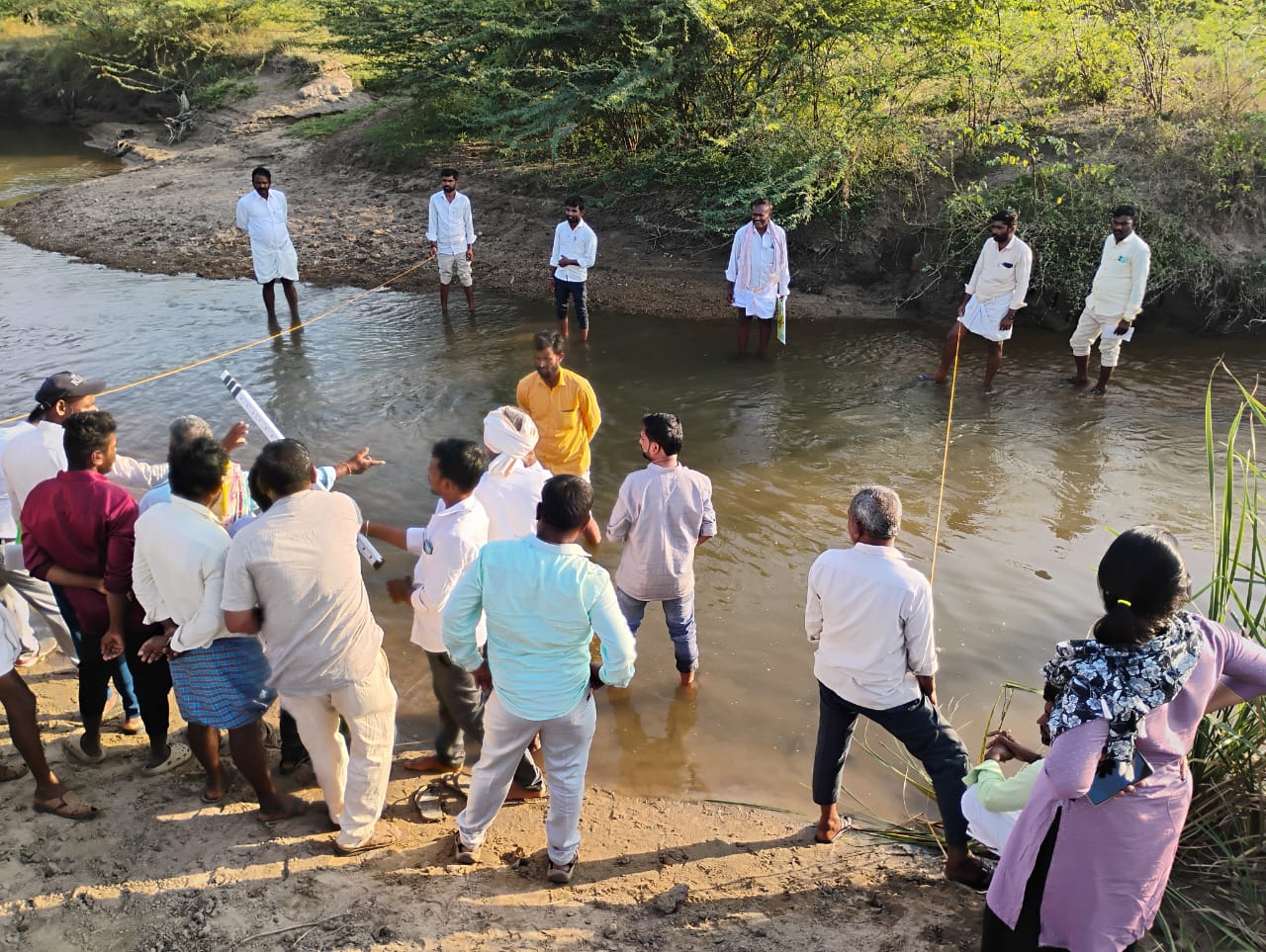
CLARITY’s community hydrology training programme bridges the gap between using practical tools and citizen science to address the complex challenges of water resilience in a changing climate. The curriculum combines short theoretical sessions and practical elements to help participants connect concepts to real-world applications. Participants with little formal education are trained in basic hydrology and how to use simple tools for well inventory and canal discharge measurements. These skills support more informed and adaptive decision-making.
Why does it matter?
The integration of the community hydrologist training curriculum into the Farmer Water Schools is expected to create a larger pool of trained community water stewards across Karnataka. These individuals will be able to support water user groups, contribute to local water budgeting, and help farmers make climate-adaptive decisions.
In Karnataka, Farmer Water Schools are an existing mechanism through which local farmers enhance their water literacy and water management through deeper understanding of practices such as water supply and demand management, groundwater recharge, and crop choice. This capacity strengthening is particularly critical in Karnataka, where increasingly unpredictable rainfall, declining water supplies, extreme heat, and drought threaten the livelihoods of more than 6 million farmers and broader food security. These challenges are compounded by the risk of additional water resource stress from agricultural overuse.
By integrating the CLARITY curriculum into its schools, ACIWRM is institutionalizing an approach that has demonstrated to be effective, contributing to its sustainability beyond the project period. In Raichur, these trained individuals are contributing to water level monitoring, water budgeting exercises, supporting discussions within Water User Cooperative Societies (WUCS), and helping farmers make more informed decisions about crop planning and water use. This has also strengthened their own capacity and agency. Four of the trained community hydrologists who supported project pilots have since secured employment with other organisations, reflecting both the relevance of their skills and the growing demand for locally grounded water‑management capacity. The wider scaling out through Farmer Water Schools offers potential for it to reach a larger population.
What did CLARE do to contribute?
The CLARITY team, through its India-based lead WELL Labs, signed a Memorandum of Understanding with ACIWRM outlining their intended collaboration early in the research process. Subsequently, the team has worked closely with ACIWRM to develop the curriculum as part of their Transformation Labs (T-Lab) approach to co-developing climate adaptation evidence and solutions alongside those expected to use them.
In Raichur, CLARITY implemented the community hydrology training curriculum in the canal command areas and rainfed landscapes and documented positive capacity strengthening outcomes among the approximately 30 participants. For example, farmers in Distributary‑10 of the canal command modified their crop choices for the 2025–26 season supported by the community hydrology training. Participants also expressed strong interest in learning more about soil moisture, crop–water relationships, appropriate borewell placement, and water‑saving practices. Evidence of these positive outcomes, combined with enthusiasm and demand from community participants and ACIWRM’s close engagement as part of the Raichur T-Lab were critical to the institutionalization of this curriculum and strengthening its potential for sustainability.
About CLARITY
The Climate adaptation and resilience in tropical drylands (CLARITY) project convenes transformational labs in the Sahel (Maradi region in Niger/Nigeria), in the drylands of central Tanzania (Dodoma) and in Peninsular India (Chintamani-Chikkaballapura and Raichur). The project team works with communities to assess water management practices, build models of plausible pathways, and embed research outcomes into wider policy and practice. CLARITY combines inclusive stakeholder engagement with innovative modeling and measurement to synthesise existing knowledge and identify promising innovations to improve climate resilience in tropical drylands.
Learn more:
Categories
Countries
CLARE Projects
CLARE Pillars
CLARE Themes
CLARE Topics
CLARE Partners