
Experts Discuss Nature-based Solutions for Climate Adaptation and Resilience in ASEAN Cities
/
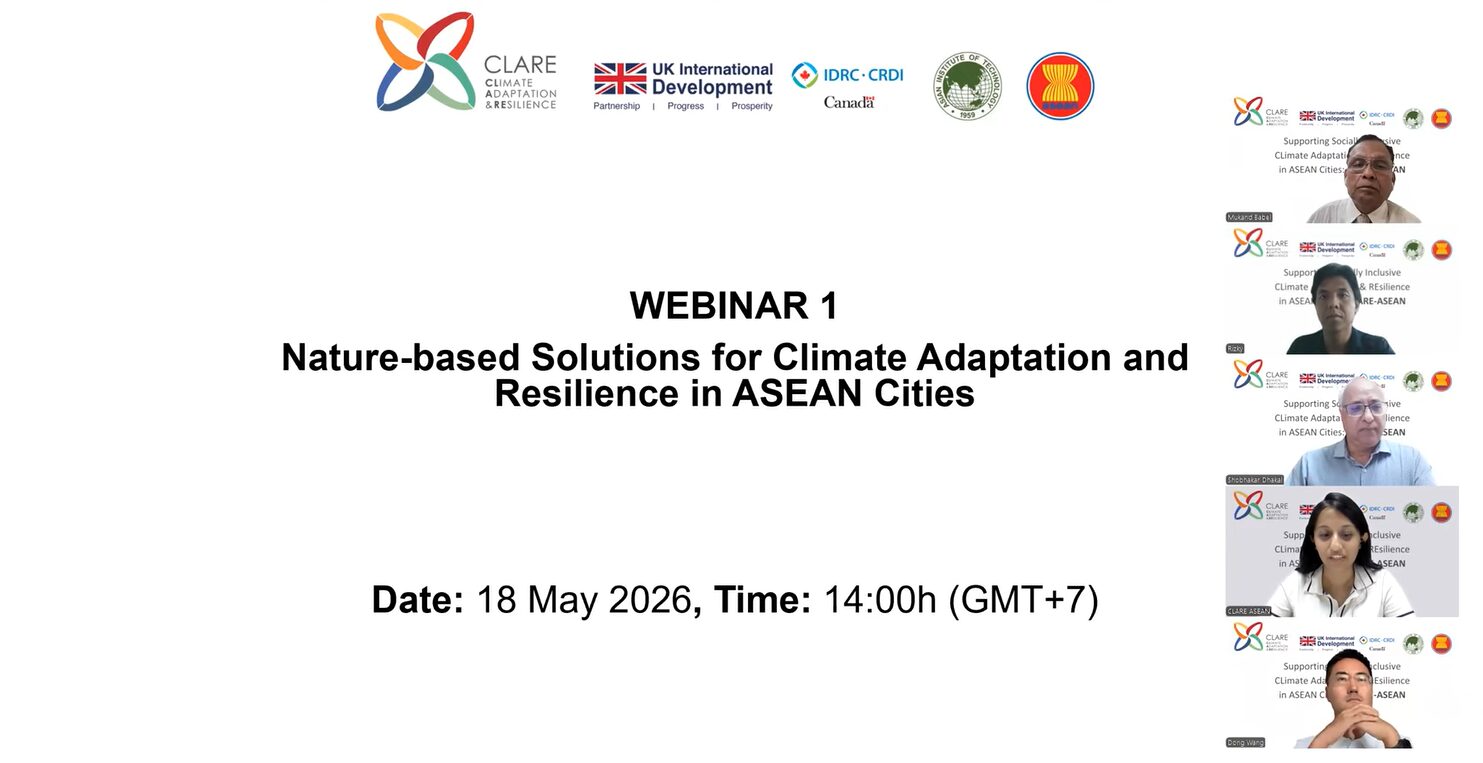
Asian Institute of Technology (AIT) successfully organized a regional webinar on “Nature-based Solutions for Climate Adaptation and Resilience in ASEAN Cities” on 18 May 2026. Conducted virtually via Zoom, the webinar brought together policymakers, researchers, practitioners, development partners, private sector, and graduate students from across the ASEAN region and beyond to discuss the growing role of Nature-based Solutions (NbS) in addressing climate challenges in urban areas. A total of 255 participants joined the webinar, reflecting strong regional interest in sustainable and inclusive climate adaptation strategies and solutions for cities.
The webinar was organized as part of the CLARE–ASEAN initiative, Supporting Socially Inclusive Climate Adaptation and Resilience in ASEAN, implemented by AIT with support from UK Aid through the Foreign, Commonwealth & Development Office (FCDO) and co-funded by the International Development Research Centre (IDRC), Canada. The initiative aims to strengthen socially inclusive urban resilience by bridging science, policy, and practice across Southeast Asia.
The session commenced with welcome remarks from Mr. Rizky Januar of FCDO, highlighting the importance of collaborative regional approaches in responding to intensifying climate risks in urban areas. Prof. Shobhakar Dhakal, AIT, introduced broadly the CLARE–ASEAN initiative and its ongoing efforts to support evidence-based climate adaptation research and policy engagement in the region. Prof. Mukand Babel, AIT, then provided an overview of the webinar including the objectives and expectations and emphasized the significance of NbS as an emerging pathway for climate-resilient and inclusive urban development.
A keynote on “Nature-based Solutions and Urban Resilience in Southeast Asia: State of the Science, State of the Art” was delivered by Dr. Perrine Hamel of Nanyang Technological University (NTU), Singapore. The keynote presented current scientific evidences, regional trends, and practical examples demonstrating how NbS interventions such as wetlands restoration, urban green spaces, mangrove conservation, and sustainable drainage systems- can enhance urban resilience while generating environmental and social co-benefits.
The webinar also featured an engaging panel discussion on “From Policy to Practice: Multi-stakeholder Pathways for Scaling Nature-based Solutions in ASEAN Cities.” The panel consisted of Prof. Dong Wang of Peking University, China; Dr. Sofia Castelo of Think City, Malaysia; Mr. Pakkasem Tongchai of IUCN Asia Regional Office, Thailand; and Mr. Stefan Rau of the Asian Development Bank (ADB). The discussion explored implementation enabling conditions and barriers, governance challenges, financing mechanisms, and opportunities for mainstreaming NbS into urban planning and policies for enhancing climate adaptation and resilience.
An interactive Q&A segment of the webinar enabled participants to exchange perspectives directly with the speakers and panelists. Audience polls conducted during the webinar revealed strong interest in topics such as urban flood management, climate governance, biodiversity restoration, and financing mechanisms for NbS implementation.
Participants responded positively to the webinar, particularly appreciating the diversity of perspectives, practical case studies, and the discussion’s relevance to contemporary urban climate challenges. They also expressed interest in future engagements focusing on Nature-based Solutions for water security and financing pathways for urban resilience
The webinar concluded with key takeaways presented by Dr. Kim Neil Irvine of Thammasat University, Thailand, followed by closing remarks offered by Dr. Arjan De Haan of IDRC. The event successfully fostered regional knowledge exchange and strengthened dialogue among stakeholders working toward climate-resilient and socially inclusive urban futures in ASEAN.
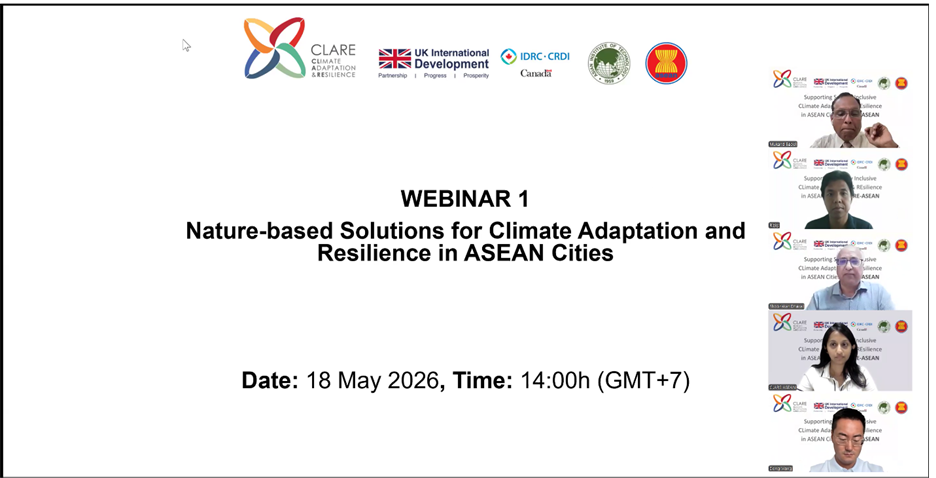
Experts and stakeholders from across the ASEAN region convene virtually for Webinar 1 of the CLARE–ASEAN initiative on Nature-based Solutions for Climate Adaptation and Resilience in ASEAN Cities, hosted by the Asian Institute of Technology (AIT) on 18 May 2026.
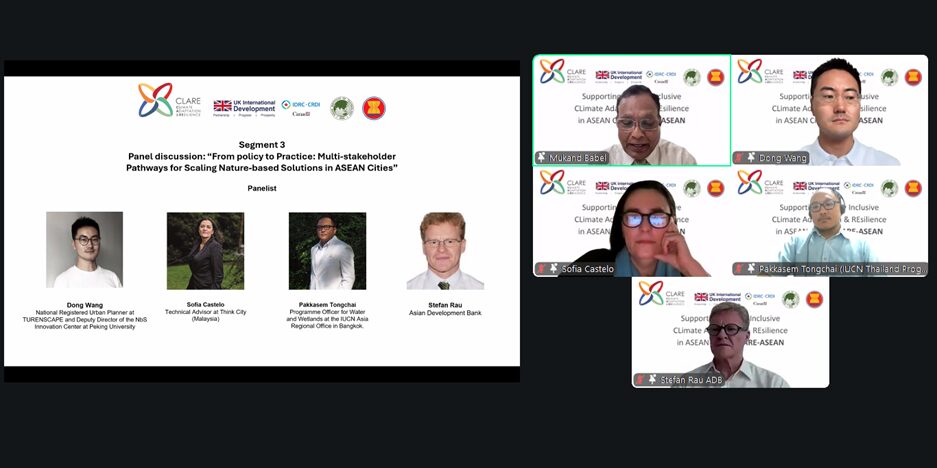
Panelists from academia, development organizations, and the private sector engage in a lively discussion on multi-stakeholder pathways for scaling Nature-based Solutions in ASEAN cities, drawing on policy frameworks, financing mechanisms, and on-the-ground experiences.
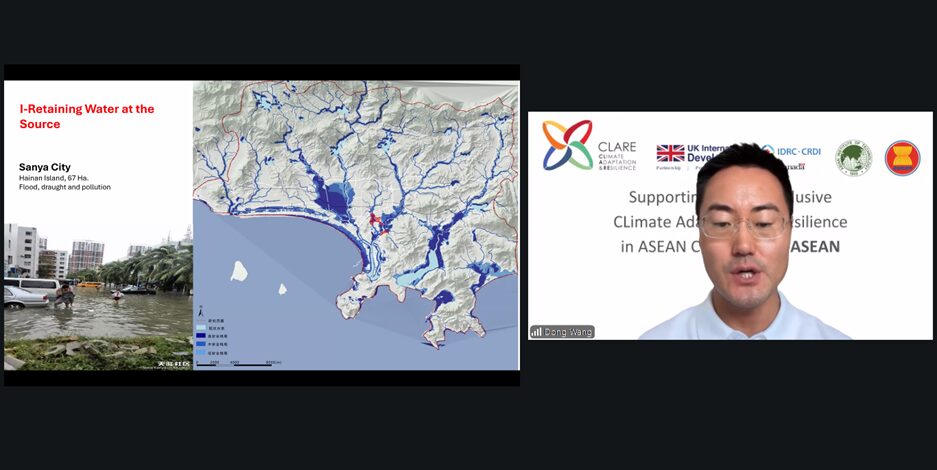
Prof. Dong Wang presents case studies from China’s Sponge City program, illustrating how large-scale NbS approaches can be integrated into urban water management and climate adaptation planning.
Categories
CLARE Pillars
CLARE Themes
CLARE Topics
Published
CLARE Projects
CLARE Partners