
Standing in the space between knowledge gaps
/
Written by Dr. Georgina Cundill Kemp
What happens when you sit at the intersection of climate science and government action? A reflection from the conference Mobility in Adaptation to Climate Change: Science, Evidence and Policy — and a frank assessment of why rigorous research alone won’t move policy.
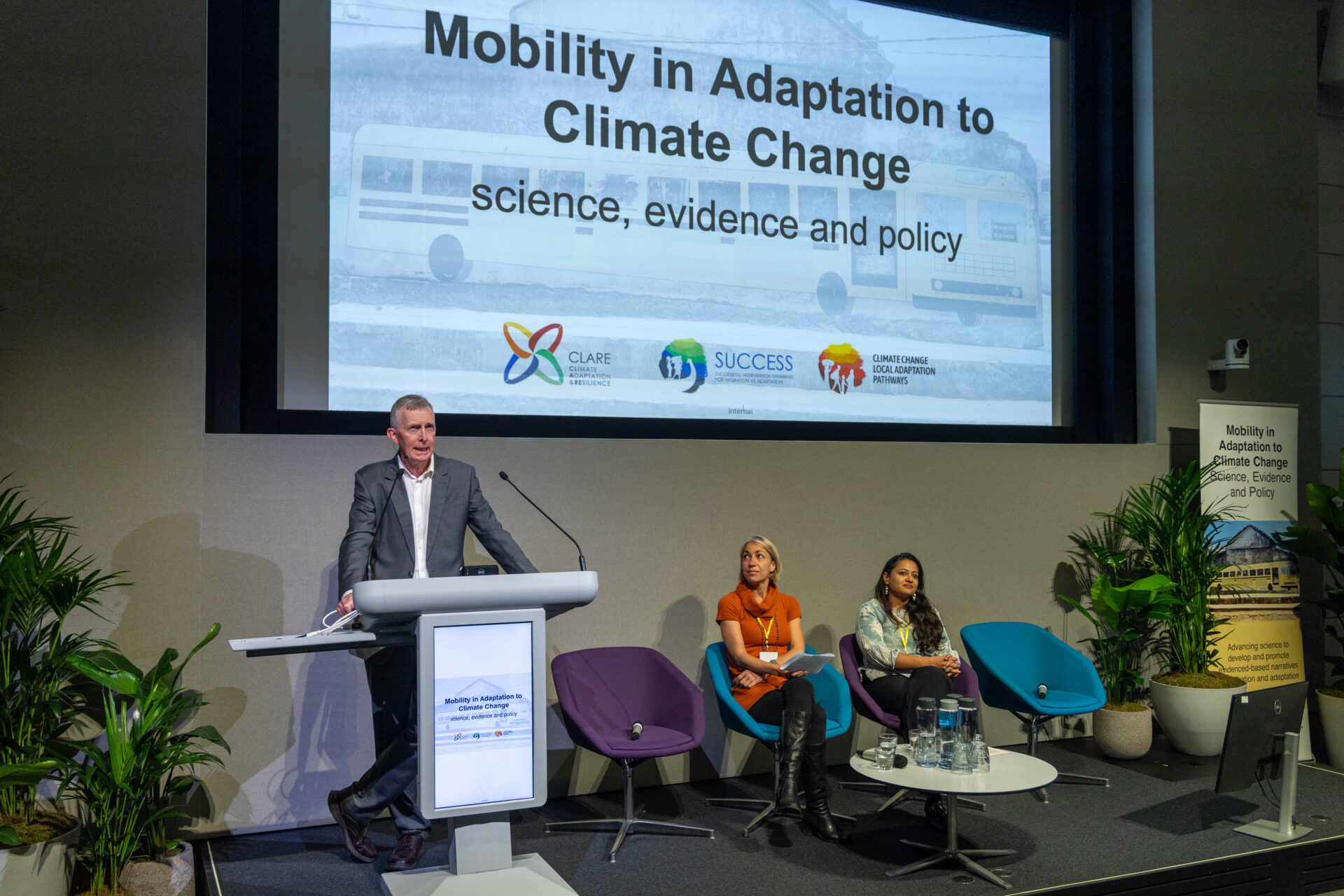
In May this year I was asked to share reflections on how migration research can spur government-level action at the conference Mobility in Adaptation to Climate Change: Science, Evidence and Policy in London. Before my remarks I listened intently, transfixed by how this field of research has matured over the past five years, while I have been immersed in other things.
I say “other things” because after a foray into climate mobilities research with some brilliant people, many of whom were hosting the conference I found myself attending that day in May, a few years ago I took a concerted leap into the chasm between evidence and policy. At the time, I wanted to understand how to drive evidence-based change, and to learn from people who do this well. As a result, I have spent the last few years in the company of intermediaries, people who inhabit the space between evidence and policy. What I have learned from groups like the Climate & Development Knowledge Network is that policy change sometimes emerges from years of relationship and trust building, and sometimes through serendipity. It emerges from careful efforts to connect different power holders in society, and by grasping windows of opportunity when change is possible.
It is also often about coaxing researchers out of the knowledge gaps they have been trained to cleave toward, and to help them to stand on the firmer ground of what is known.
And so, I sat with this understanding of policy change in the plenary of the conference, and I listened to the evidence. The evidence was robust, novel, nuanced, multi-scale, and across all sectors. I loved it, and I worried.
Because what we are learning about climate mobility poses two key challenges for efforts to influence government-level action:
- Human mobility is a cross-sectoral phenomenon, yet governments are organised in sectors. Consider the drivers of mobility, as shared at the conference: Human mobility is driven by pull factors such as economic and educational opportunities, and by push factors such as climatic events such as flooding, slow onset pressures such as drought and associated agricultural decline, and by conflict. The impacts of human mobility, by contrast, are felt in such a wide array of areas as cities, the job market and on women especially. Now consider how national governments are set up: in any given country, one will find ministries of agriculture, ministries of environment, some countries have ministries of urban development and ministries of women and girls. It is different everywhere, but the idea is the same. Ministries are sectoral. So, which ministry would a climate mobilities researcher approach with their cross-sectoral? The conundrum here is not trivial. And it is not over yet, because there is another challenge.
- Human mobility is trans-local, yet governments are organised from local to national levels with different jurisdictions at each level. During her address at the conference, Dr. Chandni Singh explained to the audience that households are now spread over space, with some members in rural areas and others living in cities and sometimes in different provinces or countries. Yet they remain one household. Now consider another aspect of how governments organise themselves. In any given country, one finds some form of the following: local or municipal government; regional or provincial government, and national government. Development funding tends to flow from national to local levels, yet in many places priorities are set by local governments but guided by national priorities. So, again, what level of government should a climate mobilities researcher approach if they are dealing with trans-local households, risks and vulnerabilities?
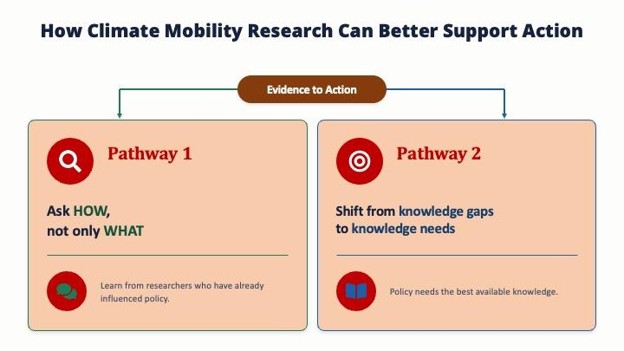
What I like about challenges is that they give us something to aim for. There are many ways for this community to support robust government-level action, but here I offer two pathways:
- Complement ‘what’ questions with ‘how’ questions: Sitting scattered throughout the conference were researchers that have successfully influenced policy already. This is a treasure trove of practical knowledge that is seldom recognised or brought to the surface in research circles. It was not on the agenda at the conference. When I asked the room I was addressing if anyone had successfully influenced policy of any kind before, not necessarily linked to mobility research, almost half the room raised their hands. The experience and knowledge base to solve the challenges I outline above already exist in this research community, we just need to ask the right questions.
- Complement the search for knowledge gaps with a search for knowledge needs: Ask any researcher what the first bit of feedback they ever got from a supervisor on their first thesis draft was, and they will probably tell you that they were asked: “but, what is the knowledge gap you are trying to address? ”This question is fundamental to research; it is how we get papers published and how we bid for funding. After a while, we live so deeply in these knowledge gaps that we lose the confidence to talk about what is known. Policy cannot be built or influenced by knowledge gaps. Policymakers have knowledge needs, which can only be filled by the best available knowledge. Best available knowledge, not unassailable knowledge. We need to get much better at speaking confidently about what is known.
I left the conference invigorated by this maturing research area, by the truly global contribution to knowledge underway, and by the enormous potential of this community to support governments to create policies that respond to the vulnerabilities and opportunities being uncovered.
Dr. Georgina Cundill Kemp is a Senior Program Specialist in climate resilience at the International Development Research Centre (IDRC). Georgina works to connect evidence to action through research programming across Africa, South Asia and Latin America. Among other things, Georgina leads the Step Change initiative, a Canada-Netherlands partnership to accelerate locally led adaptation.
Categories
Countries
CLARE Pillars
CLARE Themes
Published
CLARE Projects
CLARE Partners