
“Sustaining climate resilient water governance in the central Sahara”: a commitment to building on CLARITY’s legacy
/
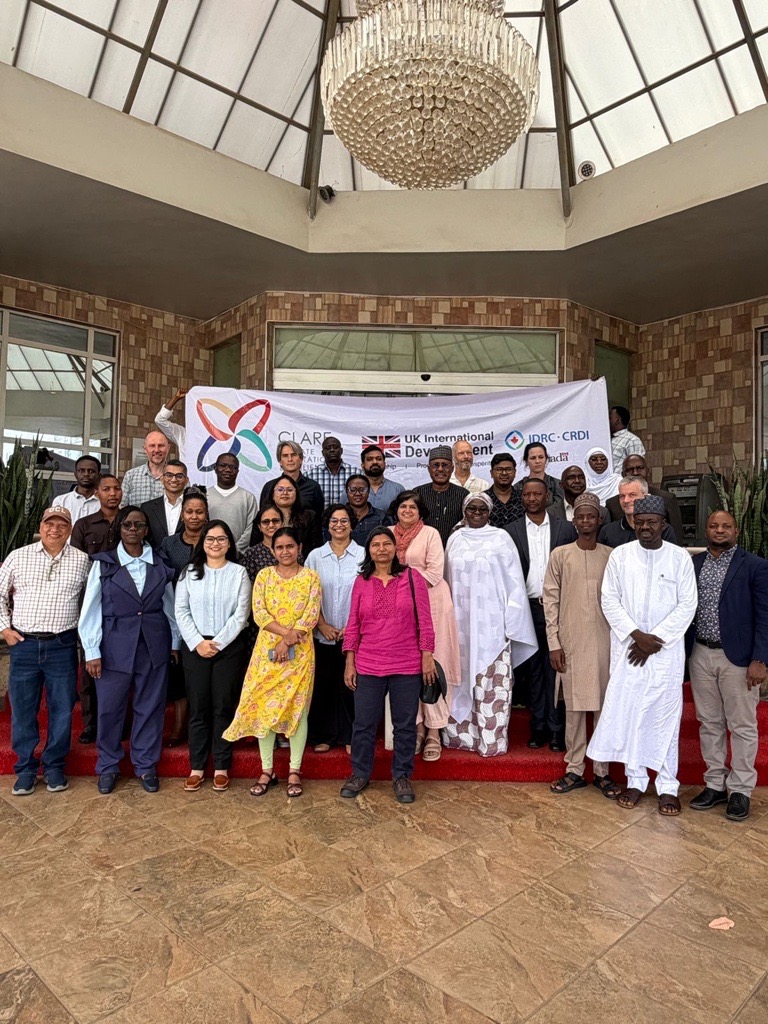
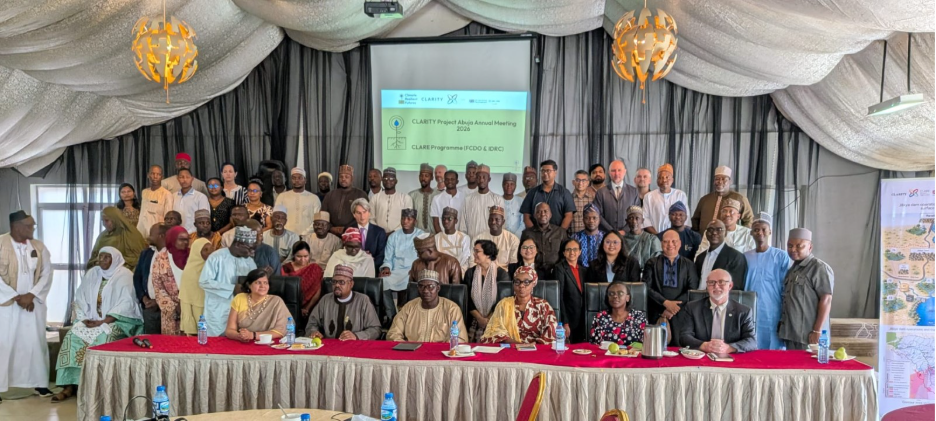
From 22 to 26 June 2026, the CLARITY Annual Meet brought members from across the CLARITY Consortium together in Abuja, Nigeria. On 24 June, participants had the opportunity to hear remarks from Professor Mohammed Al-Amin, Special Advisor on Climate Change to Katsina state government.
Prof. Al-Amin delivered a speech on “Sustaining climate resilient water governance in the central Sahara” — endorsing the work underway as part of the project and committing to build upon it within the Nigerian state of Katsina.
The speech underscored how CLARITY’s work to date has strengthened water security across the central Sahel region, highlighting key successes achieved.
“But perhaps, most importantly, CLARITY has developed what is believed to be the first calibrated, transboundary, hydrological model for the Maradi-Katsina corridor, providing an unprecedented scientific basis for evaluating future water management pathways on the changing climatic conditions. This achievement alone has immense implications for groundwater governance. For irrigation planning, for drought preparedness, and long-term water security across the central Sahel.”
Prof. Al Amin’s remarks emphasized the critical need to move climate research into policy, applauding the CLARITY team for their work to date in engaging with decision-makers. To build on this basis, Prof. Al Amin invited the CLARITY consortium and partners to collaborate with the new Climate Research Policy Working Group for Katsina State to build upon CLARITY’s work and ensure the project’s legacy endures.
This commitment to moving forward the legacy of the CLARTY project represents a key step in ensuring decision-makers and other key stakeholders are engaged to transform climate research outputs into actionable policy and development programs.
“We believe that knowledge generated under this program should not conclude with the project’s final report. Rather, it should become the foundation for a long-term climate change, knowledge ecosystem within Katsina state and beyond.”
Read the full text of Prof. Al-Amin’s remarks:
“Allow me to begin by congratulating the CLARITY consortium for what I consider as one of the most intellectually rigorous policy related climate adaptation research projects currently being implemented across the tropical drylands of Africa and Asia. The CLARITY project has demonstrated that climate adaptation research achieves its greatest value when it transcends academic inquiry and directly informs policy, planning, and community action.
At a given time, when climate change is increasingly altering hydrological systems, it is bringing droughts, aggravating flowing events, and threatening livelihoods across the Sahel. The CLARITY initiative has provided an important platform for evidence generation, stakeholder engagement, and transboundary cooperation.
The significance of this work is particularly profound for Katsina state and the region of the Nigerian Republic, where environmental realities, social economic interdependence, and shared water resources demand collaborative and science-based solutions.
What is distinguishes CLARITY from many research programs is its commitment to co-production of knowledge. The project has not merely studied communities, it has worked with the communities. It has brought together governments, researchers, traditional institutions, women, youths, water users, development partners, and policymakers in what you describe as transformation laboratories – that is the T labs. Create inclusive spaces for dialogue, experimentation, and joint problem solving.
For government states, the project has generated several strategic outcomes. These include stakeholder led assessments of water security challenges… Groundwater monitoring system, community hydrology training programs, climate clubs at schools, gender responsive water governance studies, development of sophisticated hydrological models, strengthening of transboundary dialogue between Nigeria and Niger Republic.
But perhaps, most importantly, CLARITY has developed what is believed to be the first calibrated, transboundary, hydrological model for the Maradi-Katsina corridor, providing an unprecedented scientific basis for evaluating future water management pathways on the changing climatic conditions. This achievement alone has immense implications for groundwater governance. For irrigation planning, for drought preparedness, and long-term water security across the central Sahel.
Ladies and gentlemen, one of the current challenges in climate governance globally is the persistent gap between research and policy. Excellent studies are often completed, valuable data sets are generated, important recommendations produced… yet many of these outputs remain within project reports, conference proceedings, and academic journals.
The true test of climate research is not publication. The true test is policy influence. The true test is also institutional adoption. Also, the true test is measurable impact on people’s life. That is why the session where I participate in now, which is research into policy, is particularly important. The question before us is not whether clarity has generated valuable knowledge. The question before us is, how do we ensure that the knowledge continues to shape decision making long after the project itself has ended?
Distinguished participants, a response to this question. I am pleased to announce that the government of Katsina State has currently developed an institutional framework known as the Climate Research Policy Working Group for Katsina State. This initiative is conceptualized as a permanent platform for transforming climate related research outputs into actionable policy and development program. The working group serves as a bridge between researchers, universities, government institutions, development partners, civil society organizations, traditional institutions, communities, stakeholders, and the private sector.
The vision of this working group on policy and research is to establish Katsina state as a leading knowledge-driven climate governance hub where evidence consistently informs policy, investment, and development plan. The policy working group has 6 objectives… institutionalize research to policy pathways, preserve and sustain project legacies, develop state climate knowledge repository, support evidence-based planning, promote applied research, and strengthen transboundary cooperation.
Because the foundation has already been established by this project and we can’t afford to leave it to die… that’s why the government came up with this platform, which is also contemplating, of saying how to partner with the various organizations, to see to the implementation of some pilot projects, that if successful, we can upscale it just like what the last speaker has mentioned.
So today I wish to extend an invitation to the CLARITY consortium and its distinguished partners. And we believe that knowledge generated under this program should not conclude with the project’s final report. Rather, it should become the foundation for a long-term climate change, knowledge ecosystem within Katsina state and beyond.
We therefore invite the University of Maiduguri, University of Zinder [and more] to consider supporting this working group as a post project legacy mechanism… Our ambition is simple: We want every climate related study, conducted under this project and others, in Katsina State and elsewhere, to continue to contribute directly to policy innovation. We want every dataset to support decision making, and we want every research output to get into investment and produce lasting development.
As CLARITY approaches the conclusion of its implementation cycle, it is important to recognize that successful projects should not merely end, they should evolve. The greatest legacy of CLARITY will not be the report that produced, it will not also be the models it developed. Neither will it be the workshops it organized. Its greatest legacy will be the institutions, partnerships, and capacities that continue to share climate resilient development long after the project has formerly concluded.
Katsina is committed to ensuring that this legacy endures. In our behalf of Katsina state government and the good people of Katsina we want to thank all the partner members of this wonderful exercise, and we look forward to working with you in future. Thank you very much.”
Categories
Countries
CLARE Pillars
CLARE Themes
CLARE Topics
Published
CLARE Partners