
Beyond evidence: What CLARE researchers are learning about influencing adaptation and resilience considerations across the policy landscape
/
Authors: CLARE Policy Workshop organising team
Climate adaptation research is often designed with impact in mind. Yet the journey from a research finding to a policy decision is rarely straightforward. Evidence enters crowded political and institutional spaces, where it competes with other priorities and is interpreted through relationships, incentives and local realities.
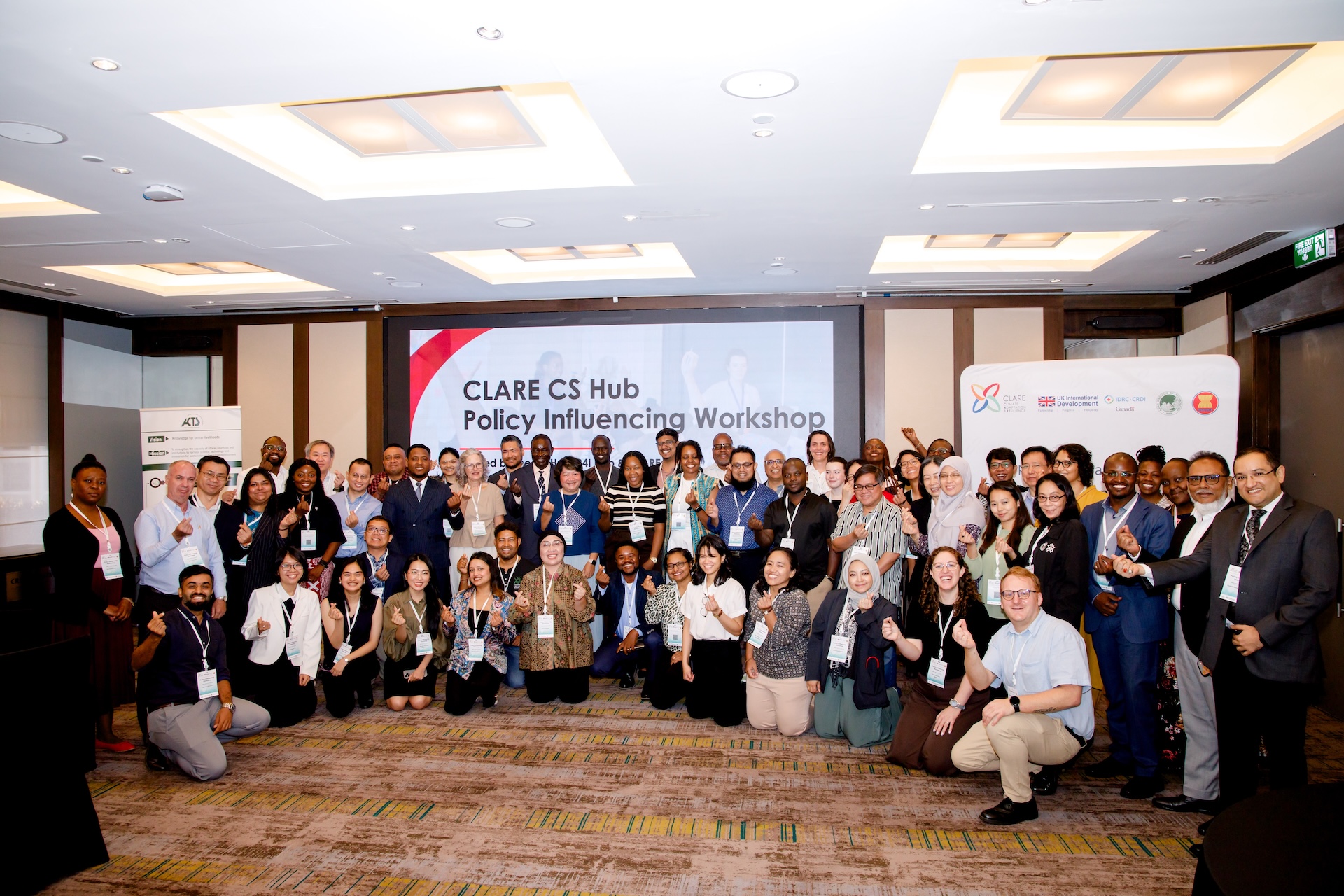
This was the starting point for the CLARE Policy Influencing Workshop, held in Bangkok, Thailand, from 22 to 26 June 2026. Organised by the CLARE Capacity Strengthening Hub in collaboration with the CLARE Research for Impact Hub and CLARE-ASEAN, the five-day workshop brought together 50 researchers and practitioners from 30 CLARE projects in Africa and Asia to reflect on their experience of engaging with policy.The aim was not simply to showcase success. Participants looked closely at where influence is emerging, what has helped, what has proved difficult, and how teams can strengthen their approach during the remaining period of their projects and beyond.
Looking beyond formal policy change
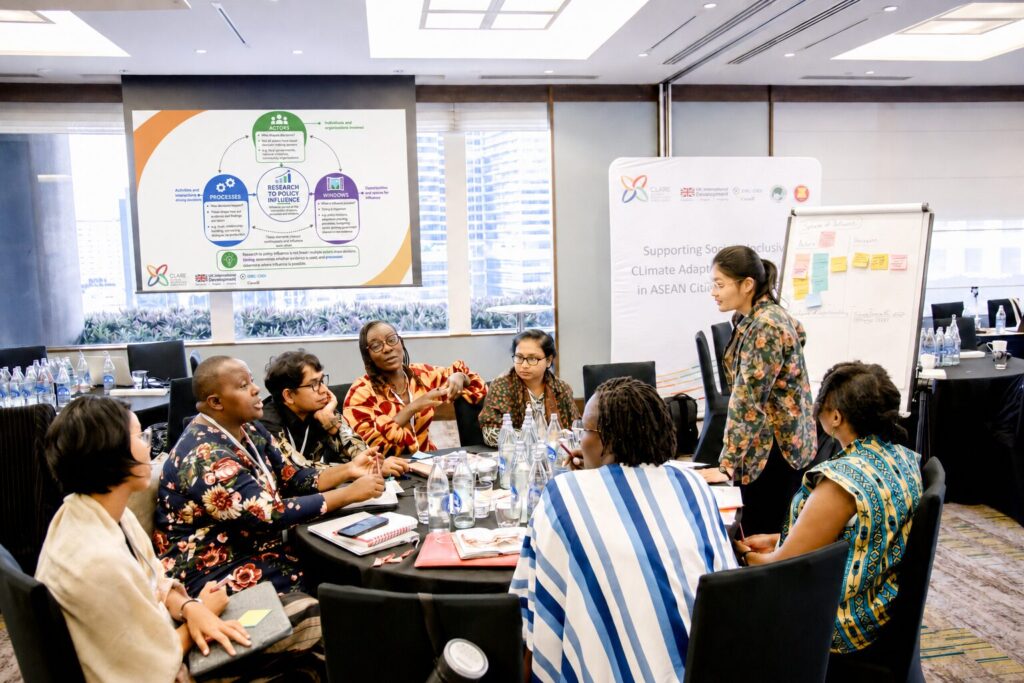
The week began with a simple but important question: what does policy influence actually look like across CLARE projects? The answers showed how varied it can be. In some cases, research had informed local plans or budgets. Elsewhere, it had drawn attention to overlooked climate risks, helped community knowledge enter decision-making, or given civil society organisations evidence they could use for advocacy.
Participants also recognised quieter signs of progress. A government department requesting more data, a project team being invited into a policy discussion, or a new actor beginning to champion an issue can all indicate that change is underway. These developments may not attract the same attention as a new policy or regulation, but they often create the conditions that make formal change possible.
This broader understanding matters because influence is usually incremental. It can begin with a shift in language, a new relationship or a better understanding of a problem long before it appears in an official document.
Capturing the progress that conventional monitoring can miss
The relational nature of policy influence creates a practical challenge for monitoring, evaluation and learning. Formal policy adoption is relatively easy to record. Changes in trust, access, relationships and public narratives are harder to capture, even though they may be just as important.
Participants shared approaches including stakeholder mapping, outcome mapping, policy analysis, reflective journals and narrative documentation. They discussed the value of recording repeated requests for evidence, invitations to policy forums, the emergence of new champions and changes in who is able to participate in a decision-making process.
The message was not that indicators are unhelpful. Rather, projects need monitoring systems that are flexible enough to notice both planned and unexpected change. They also need to explain their contribution honestly. Policy outcomes usually result from the efforts of many actors, so credible accounts of influence are more useful than claims of sole attribution.
Understanding the people and politics behind policy
A role-play exercise brought the complexity of policymaking into the room. Participants took on the perspectives of politicians, civil servants, communities, businesses, activists, journalists and researchers. Each actor brought different pressures and priorities. Political leaders considered public expectations and short-term priorities. Civil servants focused on mandates, procedures and implementation. Communities wanted tangible improvements in their lives.
Researchers often found themselves in the middle, translating evidence while trying to protect its integrity. The subsequent group discussions showed that evidence is most useful when it responds to a live need, reaches an actor with the ability to use it, and arrives when there is space for a decision to shift. It also brought trust to the forefront. Research is more likely to be viewed as legitimate when communities and local institutions help shape it, and when co-production approaches are embedded throughout the research process.
Several participants argued that researchers should not be expected to do everything themselves. Civil society organisations, journalists, policy actors and local institutions can bring skills, networks and credibility that research teams may not have. These partnerships are most effective when they are built into a project from the outset. [See more on CLARE’s focus on supporting transdisciplinary partnerships]
From reflection to a practical strategy
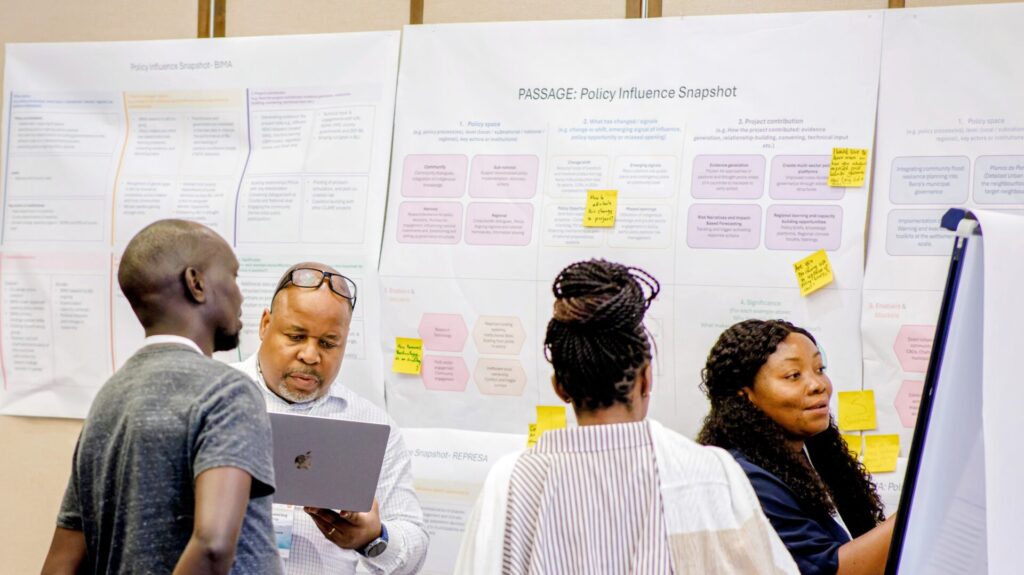
By the fourth day, the focus had turned to what project teams could do next. Through interactive activities, participants mapped their work against agenda-setting, policy formulation, implementation and evaluation, then identified immediate actions and longer-term commitments.
Their 90-day priorities were notably specific. Teams proposed co-creating local roadmaps, convening focused policy labs, and engaging planning agencies, municipal leaders and national meteorological services. This represented a move away from broad dissemination towards engagement with clearly identified actors and institutions.
The question of what happens after a project ends also ran throughout the week. Participants considered how communities can be supported as policy actors in their own right, how coalitions can be strengthened, and how evidence can be embedded in institutions and planning processes that will remain after research funding concludes.
A direct conversation with policy actors
The workshop concluded with a regional research-policy dialogue hosted by the Asian Institute of Technology. Representatives of ASEAN member states joined regional organisations, research institutions and United Nations representatives to discuss adaptation priorities, the use of evidence and the realities of implementation.
The exchange confirmed that policymakers value research that is credible, timely, locally relevant and connected to feasible action. It also illustrated how evidence can inform regional processes, including the ASEAN Climate Change Strategic Action Plan 2025-2030.
For researchers, the dialogue offered something equally valuable: a chance to test assumptions directly. What makes evidence useful to a policymaker? What prevents it from being applied? How can researchers engage in ways that support both policy development and implementation? These questions are best answered with policy actors, not on their behalf.
What CLARE will carry forward
No single model for policy influence emerged from Bangkok, nor should one have. Political and institutional contexts differ too widely for a universal formula. What did emerge was a practical set of principles: engage early and regularly with policymakers, understand the policy landscape, invest in trust, recognise informal influence, communicate with a clear purpose, monitor relationships as well as outcomes, and be prepared when a window for change opens.
These lessons will help CLARE projects sharpen their research-for-impact strategies. They will also contribute to wider programme learning about how climate adaptation research supports change across different countries, sectors and levels of governance.
The central lesson is clear. Robust evidence remains essential, but evidence achieves little in isolation. Research is more likely to support climate-resilient development when researchers, communities, practitioners and policymakers work together to interpret knowledge, build lasting relationships and shape solutions that fit the realities of implementation.
[See here, for example, how RECOVER project plans to use insights from the workshop]
Categories
Countries
CLARE Pillars
CLARE Themes
CLARE Topics
Published
CLARE Projects
CLARE Partners