

El Niño 2026-27: Implications for Climate Adaptation in Asia
/
By Ms. Sumnima Ghimire and Prof. Shobhakar Dhakal
The webinar on “El Niño 2026-27: Implications for Climate Adaptation in Asia” was a regional knowledge-sharing event specially designed, bringing experts from different fields to help us understand better about the emerging El Niño outlook, its possible implications across Asia and beyond, and see how climate information can support timely, practical, and inclusive adaptation action. The webinar was organized under the CLARE-ASEAN Initiative at the Asian Institute of Technology (AIT) and co-hosted by AQUADAPT, which is an International Development Research Centre (IDRC) and Government of Canada-funded program advancing nature-based aquaculture solutions for climate adaptation, biodiversity, and food security.
The webinar brought together researchers, policymakers, practitioners, development partners, and local government representatives to discuss emerging evidence on the potential impacts of El Niño and how these may impact climate-responsive development across marine, rural, and urban contexts in the region. Held online via Zoom on 1 October 2026, the webinar was attended by approximately 450 participants, representing a turnout rate of around 50%.
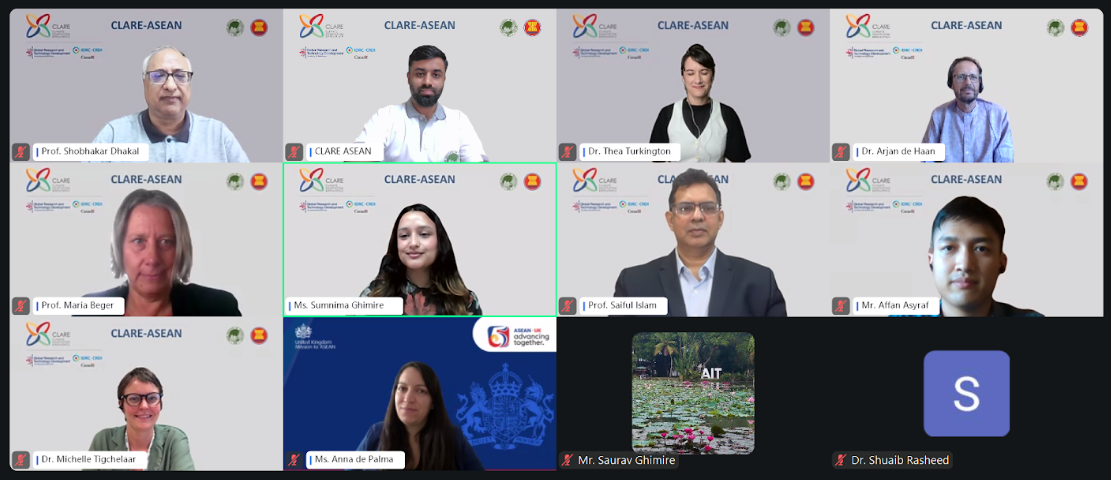
The webinar was structured into four major segments:
- Opening and Introduction: The webinar began with welcome remarks by Ms. Anna de Palma, Climate and Environment Adviser at the UK Mission to ASEAN, followed by an introduction to the CLARE–ASEAN initiative by Prof. Shobhakar Dhakal, Principal Investigator of the CLARE–ASEAN Initiative at AIT, and an introduction to the webinar by Dr. Arjan de Haan of the International Development Research Centre (IDRC).
- Panel Presentations: The panel featured Dr. Thea Turkington, Deputy Principal Research Scientist at the ASEAN Specialised Meteorological Centre; Dr. Shuaib Rasheed, Senior Research Fellow at the Research Development Office of Maldives National University; Prof. Saiful Islam of the Bangladesh University of Engineering and Technology (BUET); Prof. Maria Beger of Conservation Science at the University of Leeds; Dr. Michelle Tigchelaar, Lead Scientist at WorldFish; and Mr. Affan Asyraf, GEDSI Research Analyst at the World Resources Institute (WRI) Indonesia.
- Moderated Discussion: The discussion was moderated by Dr. Arjan de Haan of the International Development Research Centre (IDRC). Questions raised by participants were addressed by the relevant speakers.
- Closing and Way Forward: The webinar concluded with closing remarks by Prof. Shobhakar Dhakal, Principal Investigator of the CLARE–ASEAN Initiative at AIT.
Key Takeaways and Recommended Actions
The webinar emphasized that El Niño is a stress test for climate adaptation. Although it is a natural climate phenomenon, it is now occurring in a warmer world, amplifying risks and creating cascading impacts across water, food, health, oceans, livelihoods, and cities.
El Niño changes probabilities rather than providing certainty. Warmer and drier conditions are likely across much of Southeast Asia, with peak heat expected between March and May 2027; however, impacts will vary, and some areas may experience wetter conditions. Those most at risk include reef-dependent coastal communities, small island states, rain-fed farmers, artisanal fishers, aquaculture farmers, and women working in fisheries.
A key gap identified during the webinar was the difficulty of translating climate science into practical, locally relevant guidance. Fisheries and aquaculture, in particular, remain insufficiently integrated into El Niño preparedness.
The speakers highlighted several priority actions:
- Strengthen monitoring and early warning: Track ocean temperatures and coral-bleaching risks while improving seasonal and sub-seasonal forecasting.
- Provide usable and localized advice: Deliver crop- and location-specific guidance through radio, community committees, WhatsApp, and extension services, linked where possible to financial assistance and social protection.
- Protect coral reefs: Reduce pollution, habitat degradation, and coastal reclamation, while protecting reefs that demonstrate greater-than-expected resilience. The use of heat-tolerant corals for restoration should be considered carefully, given the potential trade-offs.
- Promote equitable governance: Protect both marine resources and the people who depend on them, ensuring that the responsibilities and benefits of conservation are shared fairly.
- Support livelihood diversification: Some fishing communities may need assistance to diversify their livelihoods, while changing fish availability may also require adjustments in consumption patterns.
- Build on local and traditional knowledge: Many effective adaptation solutions draw on traditional practices and locally managed approaches.
- Connect El Niño preparedness with long-term adaptation: Adapting to climate change strengthens resilience to El Niño and other climate-related hazards.
- Deepen regional and global collaboration: Cooperation is particularly important for small island states and other highly exposed countries with limited resources and capacity.
Missed the session? Watch the full recording.
Categories
CLARE Pillars
CLARE Themes
CLARE Topics
Published
CLARE Projects
CLARE Partners