
Story of change: Strengthening women’s agency in tidal surge mitigation and disaster response
Published on
Authored by Tracey Philips (Southern Hemisphere, CLARE programme evaluation team) with inputs from the SURF-IT project team
CLARE Stories of Change are snapshots of how research and capacity strengthening initiatives that the programme supports are contributing to specific changes on the ground in support of resilience to climate change and natural hazards. They help illustrate how CLARE is enabling socially inclusive and sustainable climate resilience, as outlined in the CLARE Theory of Change.
What changed?
In Satkhira and Khulna districts of southwest coastal Bangladesh where populations face increasingly frequent and intense cyclones, local women are acting on new knowledge and strengthened capacities to monitor the embankments in their communities and report possible breaches to the SURF-IT project team and local authorities. These women are members of newly established women’s groups supported through engagement and capacity strengthening by the SURF-IT team in response to a gender analysis and set of recommendations completed in late 2024.
Members of these groups are developing local networks for communication and collaboration to ensure timely community responses to tidal surges. They have reported shifts in their understanding of early warning systems and disaster management services, as well as in their knowledge of how to go about accessing these resources. Participants have also strengthened their communication skills and become more confident in engaging with other members of their communities.
“Before this project we did not know that lady who lives near the river. Now, we are getting to know each other. So if she sees that the river water height is increasing, she immediately calls to the other community groups.… there is a sense of responsibility for one another, that we are not alone, but can rely on and prepare with others.” — Women’s group participant
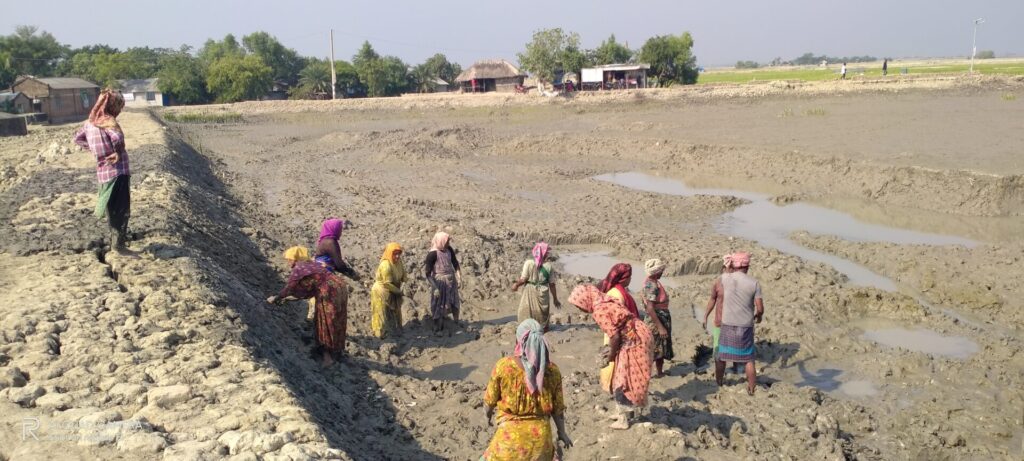
Photo credit: SURF-IT project team
Why does it matter?
The south-west coastal region of Bangladesh is highly vulnerable to tidal surges caused by cyclones, which are increasing in frequency and intensity under a changing climate. Many coastal embankments have proven insufficient, yielding to overflows or breaking during tidal surges. These embankment breaches result in flooding, waterlogging, and salinity intrusion, impacting rural livelihoods through effects on agriculture and fish farming, and damaging infrastructure. Breaches can also cause displacement and health crises, including outbreaks of cholera, dysentery, and typhoid.
Women are especially vulnerable due to their responsibilities for household management and their reliance on informal or subsistence-level income-generating activities such as small-scale agriculture – often in the absence of their husbands, who typically leave the villages in search of employment or other economic opportunities. Women also typically have limited access to information and communication channels, and decision-making structures.
The establishment of the community women’s groups is ensuring that women can play a key role in the local response to tidal surge risk mitigation and disaster response. Women are now more knowledgeable about EWS and are able to warn fellow community members about possible flooding to mitigate damage to – or loss of – household assets. They are also more confident to act in a leadership capacity and to engage with local government and non-governmental structures to inform them of areas where embankments have been weakened to ensure that timely repairs can be undertaken. Of note is that the capacity strengthening on EWS is also giving women the confidence and skills to advocate for their rights, to ensure a more effective response to their concerns and priorities during disaster situations, and to address other gender-related challenges.
What did CLARE do to contribute?
In 2024, the SURF-IT team conducted an analysis to explore gender-based vulnerabilities in areas experiencing tidal surges and strengthen the design and implementation of gender-responsive project strategies. Based on their findings, they engaged with community members to roll out evidence-informed support to strengthen the role of women in local disaster response and risk mitigation efforts – including supporting the establishment and capacity strengthening of these women’s groups.
This work included leveraging relationships with communities to recruit members and leaders of women’s groups in the 20 unions targeted by SURF-IT, spread across three Upazilas (Assasuni and Shayamnagar in Satkhira district, and Koyra in Khulna district). Following the formation of the women’s groups, SURF-IT conducted a number of capacity strengthening sessions with the selected members, including training on gender and women’s rights, women’s leadership, advocacy, and early warning systems. Information on Early Action Protocols (EAPs) was also shared to ensure that the women’s groups can play an active role in disaster risk reduction (DRR) efforts.
Learn more:
- Blog- AI-Driven Surge Prediction: Safeguarding Bangladesh’s Coastal Communities
- Blog – Assessing the Impact of Tidal Surges on Rural Households: Findings from a Baseline Study
- Blog – Community-Led Embankment Management in Coastal Bangladesh
About SURF-IT
SURF-IT aims to support the development of impact-based forecasts of water surge levels in selected inland tidal estuaries of Southwest coastal regions of Bangladesh, with the option of scaling it nation-wide. Those forecasts promise to significantly improve the existing Early Action Protocols to reduce the impact of the surge on coastal people, especially on women and vulnerable groups, benefitting more than half a million people by the end of the project.
Categories
Countries
CLARE Projects
CLARE Pillars
CLARE Themes
CLARE Topics
CLARE Partners