

Urban Planning and Governance for Climate Adaptation and Resilience in ASEAN Cities: Reflections from the CLARE-ASEAN Regional Workshop
/
By Ms. Sumnima Ghimire, Dr Priya Singh, and Prof. Shobhakar Dhakal
Planning and governance are foundational to strengthening urban climate adaptation and resilience across ASEAN cities. As climate risks become increasingly intertwined with land use, infrastructure provision, ecological management, housing systems, and urban development processes, adaptation can no longer be treated as a standalone environmental concern. Instead, it requires governance systems capable of coordinating across sectors, scales, and institutions to address the complex and interconnected nature of urban climate risks.
Urban planning and governance are enabling conditions for strengthening urban climate adaptation and resilience. While planning systems across ASEAN are often formally established and institutionally extensive, climate adaptation remains only partially integrated within them. Climate risks continue to be addressed through sector-specific approaches, despite their implications for infrastructure, transport, public health, housing, ecological management, water systems, and disaster risk reduction. Another key challenge lies in the fragmented nature of planning and governance systems. Climate risks associated with flooding, heat stress, watershed degradation, ecological decline, mobility systems, and infrastructure strain frequently extend across administrative boundaries and institutional jurisdictions. However, responsibilities for land use, infrastructure, housing, transport, water management, environmental protection, and disaster risk reduction often remain divided across multiple agencies, undermining the implementation of integrated urban adaptation strategies across many ASEAN cities.
Experiences across the participating countries pointed to a recurring governance challenge: the fragmentation of responsibilities across planning, environmental management, infrastructure, and finance institutions. Whether in rapidly urbanising cities such as Hanoi and Phnom Penh or in more institutionally established contexts such as Bangkok and Selangor, adaptation efforts often struggled to bridge sectoral boundaries and connect evidence generation with implementation and investment processes.
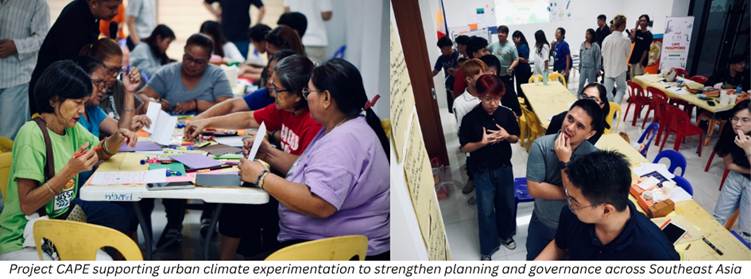
The effectiveness of adaptation planning is further constrained by the disconnect between planning frameworks and implementation systems. Although many cities have developed master plans, climate strategies, and resilience frameworks, these often remain weakly linked to budgetary processes, financing mechanisms, monitoring systems, and institutional accountability structures. As a result, long-term adaptation goals are frequently articulated in policy documents but struggle to translate into operational actions. Planning systems, therefore, need not only to articulate long-term adaptation goals but also to translate them into operational governance mechanisms with clearly assigned responsibilities, financing structures, and implementation pathways.
Rapid urbanization presents additional governance challenges. Informal settlement growth, ecological encroachment, and speculative land-use change frequently outpace the capacities of planning institutions and regulatory systems. Enforcing planning regulations has been difficult in contexts where ecological systems, waterways, wetlands, and agricultural land continue to face increasing development pressure. Adaptation planning often confronts political and institutional constraints linked to land markets, competing development priorities, fragmented administrative systems, and uneven regulatory enforcement.
At the same time, climate adaptation remains fundamentally local in both its impacts and implementation requirements. Effective planning depends on understanding local vulnerability patterns, ecological conditions, infrastructure access, and community needs. Context-sensitive approaches are therefore essential, as cities and communities experience climate risks in different ways. Planning frameworks that overlook these differences risk failing to address the uneven distribution of vulnerability across urban populations and settlements. Likewise, governance legitimacy and participation are equally important for strengthening urban resilience. Community knowledge, local experience, and everyday adaptation practices provide valuable insights into how climate risks are experienced and managed on the ground, yet these perspectives often remain insufficiently integrated within formal planning systems. Climate adaptation, therefore, requires governance arrangements that engage civil society, youth groups, local communities, and vulnerable populations not only through consultation processes but through more sustained forms of participation and institutional inclusion.
The growing uncertainty associated with climate change highlights the need for more adaptive and flexible planning approaches. Conventional planning systems are often based on fixed assumptions and long implementation timelines, while climate risks continue to evolve. Adaptation planning, therefore, needs to respond iteratively to changing climatic conditions, emerging vulnerabilities, and evolving urban realities. In this regard, it is not a fixed technical exercise but an ongoing governance process requiring institutional learning, monitoring systems, cross-sector coordination, and periodic recalibration.
Planning approaches across ASEAN cities demonstrate both progress and persistent constraints in translating climate priorities into action. While frameworks increasingly address areas such as watershed management, flood mitigation, blue-green infrastructure, and climate-sensitive land use, implementation remains limited by weak institutional coordination, fragmented financing, and inconsistent policy enforcement. A recurring gap between planning and budgeting systems further weakens execution, underscoring the need for stronger alignment between adaptation priorities, investment frameworks, and national strategies. It is understood that the future resilience of ASEAN cities depends not only on technical planning tools but also on sustained institutional coordination, governance capacity, and long-term political commitment capable of integrating climate considerations into core urban development processes.
CLARE-ASEAN organized a Regional Workshop and Dialogue on Strengthening Urban CLimate Adaptation and REsilience in ASEAN: Bridging Knowledge-Policy-Action Gaps, 12–13 May 2026, at Crowne Plaza Bangkok Lumpini Park.
Categories
CLARE Pillars
CLARE Themes
CLARE Topics
Published
CLARE Projects
CLARE Partners