

Gender Equality and Inclusion (GEI) in Urban Climate Adaptation and Resilience: Reflections from the CLARE-ASEAN Regional Workshop
/
By Ms. Sumnima Ghimire, Dr Priya Singh, and Prof. Shobhakar Dhakal
Gender Equality and Inclusion (GEI) are fundamental to understanding how climate vulnerability, adaptation, and resilience are experienced across ASEAN cities. Climate risks are not distributed evenly; rather, they are shaped by unequal social relations, institutional hierarchies, precarious labour systems, and unequal access to urban resources, infrastructure, and decision-making processes.
Exposure to heat stress, flooding, displacement, ecological degradation, and infrastructural precarity cannot be understood through environmental indicators alone. Vulnerability is closely influenced by housing conditions, labour arrangements, migration status, informal economies, income inequality, disability, age, and access to services and institutional protection systems. As a result, climate impacts often fall disproportionately on groups that already face social and economic disadvantages.
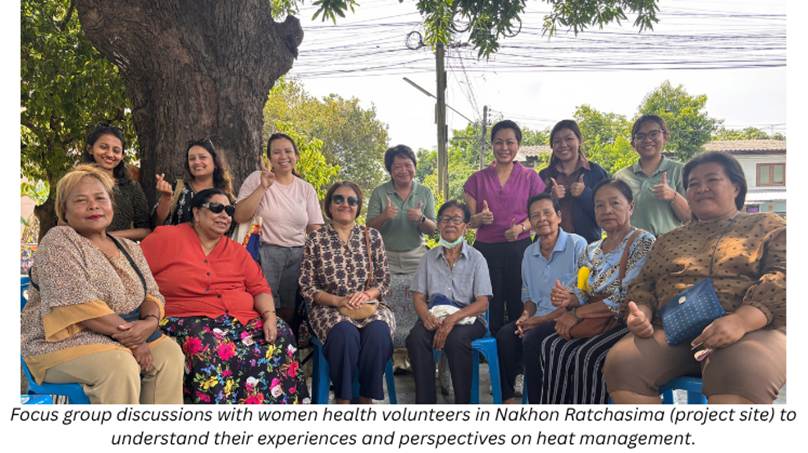
Country discussions also highlighted how climate risks intersect with gender, livelihood conditions, and social vulnerability. In Bangkok, household surveys associated with green infrastructure and heat adaptation assessments incorporated gender, income, age, and mobility indicators to understand differential access and benefits better. In Indonesia and Malaysia, heat exposure was closely linked to housing conditions and the everyday realities of low-income communities. At the same time, in the Philippines, participatory processes deliberately engaged women, informal settlers, and other marginalised groups in adaptation planning. These experiences suggest that inclusive climate adaptation requires attention not only to environmental risks but also to the social and institutional conditions that shape vulnerability and adaptive capacity.
Understanding these patterns of vulnerability also requires attention to questions of power and governance. Adaptation frameworks are often shaped by top-down institutional structures that prioritize technocratic expertise, formal planning systems, and externally generated knowledge, while community experiences and informal adaptation practices receive comparatively limited recognition. This raises important questions about who defines urban risk, whose vulnerabilities become visible within policy systems, and whose priorities are reflected in adaptation planning.
Within such systems, those most exposed to climate risks frequently have the least influence over adaptation decision-making processes. Informal workers, migrants, low-income women, elderly populations, renters, and residents of precarious settlements often experience adaptation not as participation within governance systems, but as exposure to decisions shaped elsewhere through institutions to which they have limited access. Addressing vulnerability, therefore, requires moving beyond approaches that view affected populations solely as recipients of assistance and instead recognizing the structural inequalities that continue to shape exposure and adaptive capacity.
At the same time, valuable knowledge on climate adaptation exists beyond formal institutions. Everyday experiences of coping with flooding, heat exposure, water scarcity, insecure housing, and livelihood disruption provide important insights into local adaptation practices. However, these forms of knowledge frequently remain underrepresented within planning and governance systems, which often privilege quantitative data, technical modelling, and external assessments. This reflects the persistence of epistemic hierarchies within adaptation governance, where some forms of knowledge acquire institutional legitimacy while others remain informal, invisible, or insufficiently recognized.
These inequalities are also reflected in the ways adaptation interventions are planned and implemented. Questions of inequality and socio-spatial exclusion remain central to urban adaptation efforts. Interventions such as ecological upgrading, infrastructure improvements, resilience-oriented redevelopment, and environmental enhancement projects may improve environmental conditions in some areas while simultaneously contributing to rising land values, displacement pressures, or unequal access to urban space. Adaptation cannot, therefore, be assumed to produce socially just outcomes unless issues of equity and inclusion are explicitly considered throughout planning and implementation processes.
Migration and mobility represent another important dimension of urban climate vulnerability, particularly in relation to informal labour systems and climate-related displacement. Migrants and mobile populations frequently remain insufficiently reflected within urban planning systems despite playing central roles in urban economies. In many ASEAN cities, migrant workers occupy highly exposed forms of labour while simultaneously having limited access to formal housing, social protection systems, healthcare infrastructure, and institutional representation. Their experiences highlight the tension between urban economies that depend on precarious labour systems and adaptation frameworks that continue to be organized primarily through formal administrative categories and territorially fixed governance structures.
Addressing these challenges requires rethinking what meaningful inclusion entails. Inclusion requires more than participation through consultation exercises alone. It also requires the ability to influence planning priorities, resource allocation, implementation systems, and governance processes. Strengthening urban climate resilience, therefore, depends not only on distributing resources more equitably but also on redistributing institutional authority and epistemic legitimacy. Supporting such approaches also requires stronger and more inclusive evidence systems. The importance of context-sensitive and disaggregated evidence remains critical. Many dimensions of vulnerability, including informal labour, unpaid care work, undocumented migration, insecure tenure, and precarious housing conditions, are often insufficiently reflected in conventional climate assessments. Understanding these intersecting realities is essential for developing adaptation strategies that respond to the lived experiences of vulnerable populations across ASEAN cities.
CLARE-ASEAN organized a Regional Workshop and Dialogue on Strengthening Urban CLimate Adaptation and REsilience in ASEAN: Bridging Knowledge-Policy-Action Gaps, 12–13 May 2026, at Crowne Plaza Bangkok Lumpini Park.
Categories
CLARE Pillars
CLARE Themes
CLARE Topics
Published
CLARE Projects
CLARE Partners